
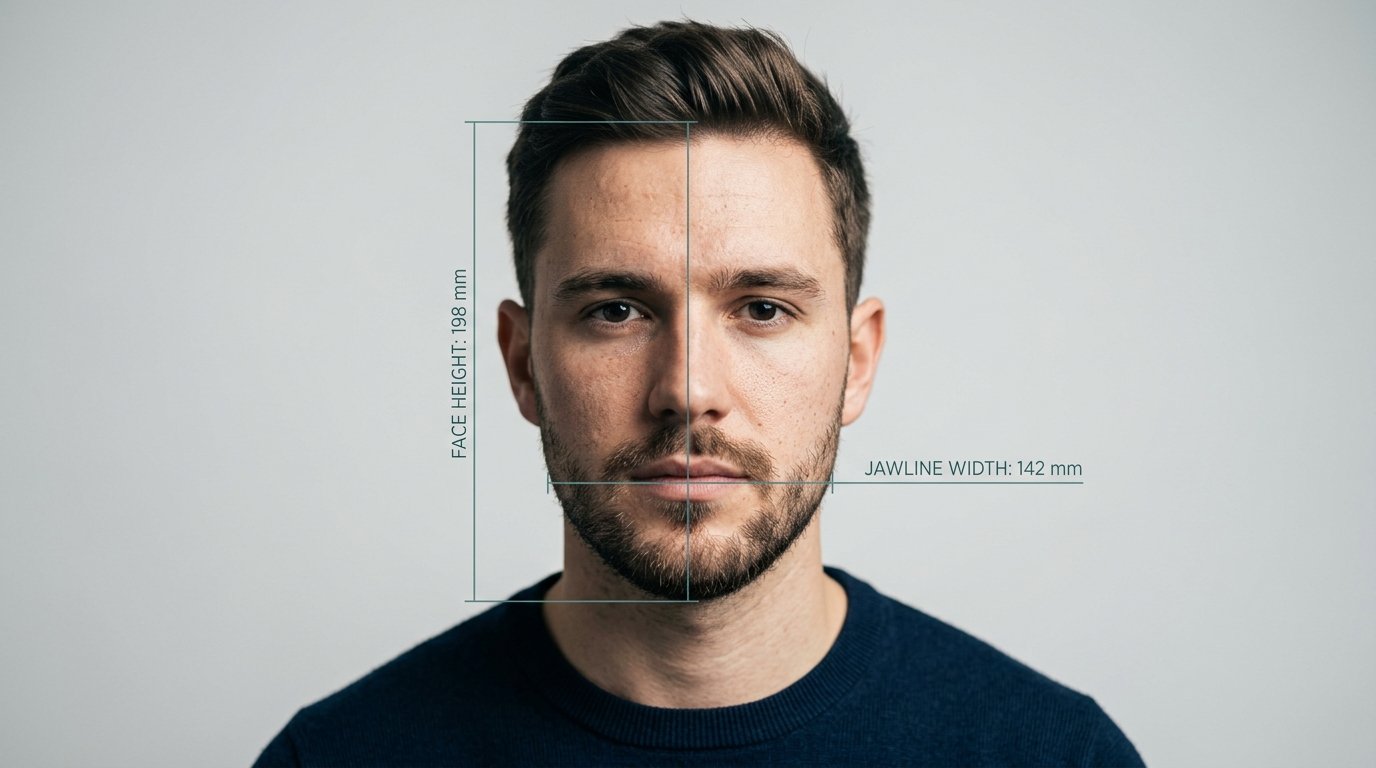
The jawline-to-face ratio compares your jaw width to your overall face height (or cheekbone width). The ideal jaw width sits at roughly 60–70% of your cheekbone width. For most people, a jaw width between 0.60 and 0.72 of their bizygomatic width represents optimal facial balance — with the higher end associated with stronger masculine definition.
What Is the Jawline-to-Face Ratio?
Your jawline is one of the most defining features of your face — but its impact on overall attractiveness isn't just about whether it looks “sharp.” The jawline face ratio is a measurable relationship between the width of your jaw and the dimensions of your face as a whole. It encodes a remarkable amount of biological information: hormonal history, bone density, genetic health, and even developmental stability during adolescence.
Unlike many subjective beauty metrics, the jawline-to-face ratio is quantifiable. Researchers in evolutionary biology, cosmetic surgery planning, and AI-based facial scoring all use jaw width measurements relative to facial height or cheekbone width to assess proportional harmony. The ratio helps explain why certain faces read as “strong,” “refined,” or “balanced” — without anyone being able to articulate exactly why.
Understanding your own ratio gives you an objective lens through which to interpret your facial structure, make informed styling decisions, and understand what cosmetic or looksmaxxing interventions might have the most meaningful impact.
Want to see how your jaw scores alongside your other facial features? Try our free Face Rater tool — results in under 10 seconds.
How to Measure Your Jawline-to-Face Ratio
The jawline-to-face ratio can be measured in two main ways: jaw width relative to cheekbone width (the most commonly used in research) or jaw width relative to total face height. Both are useful, and together they give you a complete picture of your lower facial proportions.
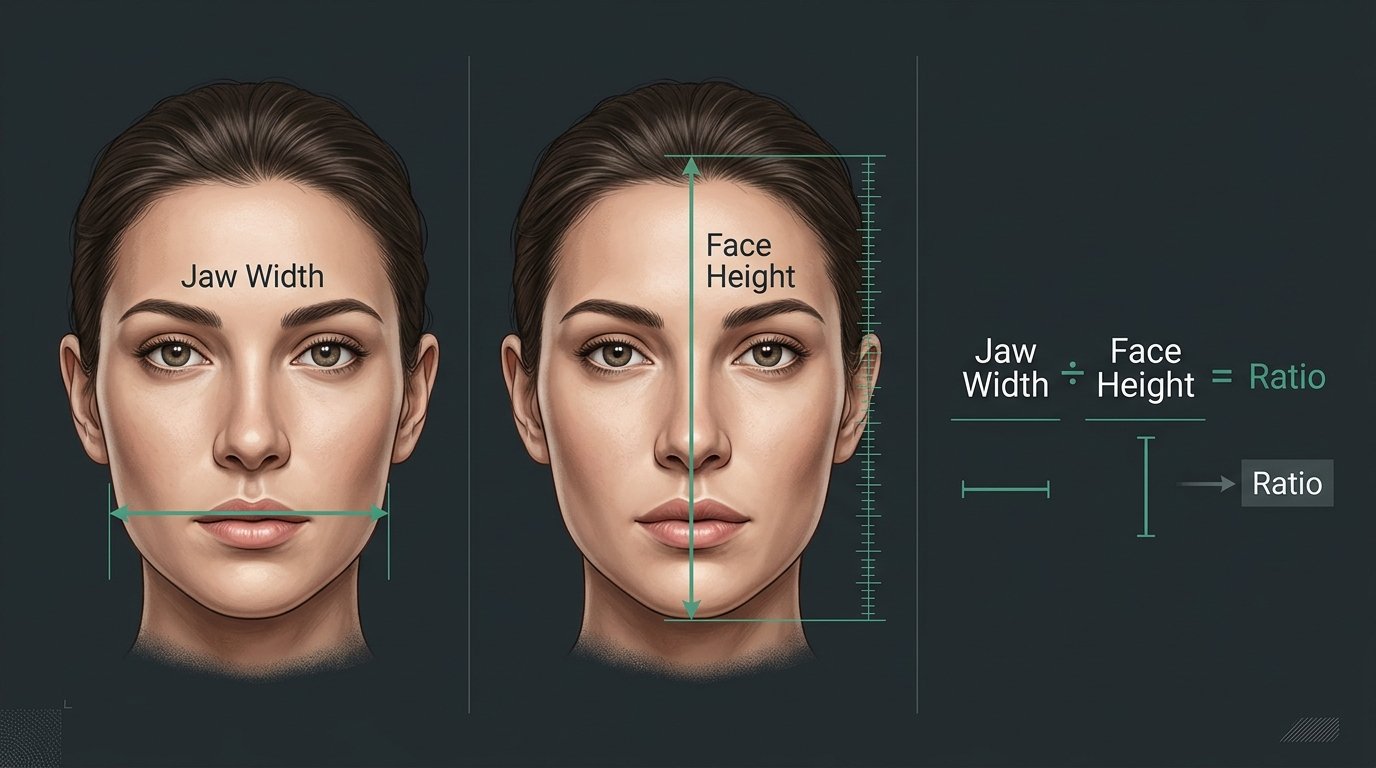
Method 1: Jaw Width ÷ Cheekbone Width — Divide the horizontal distance between your jaw angles by the widest point across your cheekbones.
Method 2: Jaw Width ÷ Face Height — Divide jaw width by the vertical distance from your hairline to your chin tip.
Step-by-Step Measurement Instructions
- Find your jaw angles (gonion points): Place your fingertips behind the lower edge of your earlobes and slide downward until you feel the corner of your jaw — where it turns from vertical to horizontal. This is your gonion. Do this on both sides.
- Measure jaw width: With a soft tape measure, measure horizontally between your two gonion points. Hold the tape flush with your skin, just below your ears. Record in centimetres.
- Measure your cheekbone width: Find the outermost bony prominence of each cheekbone (just below and slightly in front of each eye socket). Measure horizontally between them — this is your bizygomatic width.
- Measure total face height: Measure vertically from your hairline midpoint to the very tip of your chin.
- Calculate your ratios: Divide jaw width by cheekbone width (Method 1) and jaw width by face height (Method 2). Compare both to the table below.
Example: Jaw width = 12.2 cm, cheekbone width = 14.8 cm, face height = 22.0 cm.
→ Method 1: 12.2 ÷ 14.8 = 0.82 (jaw is 82% of cheekbone width — very strong jaw)
→ Method 2: 12.2 ÷ 22.0 = 0.55 (jaw width is 55% of face height — balanced)
Not sure what face shape your proportions produce? Use our free Face Shape Detector to identify your shape in seconds and understand how your jaw fits your overall structure.
What Is the Ideal Jawline Ratio?
The concept of an “ideal” jawline ratio differs meaningfully between sexes, which is one reason it’s worth separating the data. What reads as attractive in a male face often differs from what’s rated highest in a female face — a reflection of the different hormonal signatures each structure communicates.
| Jaw / Cheekbone Ratio | Category | Typical Perception | Common in |
|---|---|---|---|
| Below 0.55 | Very narrow jaw | Delicate, childlike, petite chin structure | Oval / oblong faces |
| 0.55 – 0.62 | Refined / feminine | Elegant taper; highly rated in women | Heart, oval faces |
| 0.63 – 0.70 | Balanced (ideal zone) | Proportionally harmonious; most universally attractive | Oval, diamond faces |
| 0.71 – 0.80 | Strong / masculine | Dominant; high testosterone signal; attractive in men | Square, diamond faces |
| Above 0.80 | Very wide jaw | Heavy brow, strong bone structure; striking but less common | Square faces |
For men, research from evolutionary biology consistently shows that broader jaw structures — those in the 0.70–0.80 range relative to cheekbone width — signal pubertal testosterone exposure and are associated with perceived dominance, health, and social status. This is part of why a well-defined jawline is one of the highest-impact features on the PSL Scale scoring rubric used in looksmaxxing communities.
For women, attractiveness peaks in the more tapered range. A jaw width roughly 60–65% of the cheekbone width, combined with a slightly pointed chin, creates the classic heart or oval silhouette that scores highest across multiple cross-cultural studies.
Curious what the PSL Scale actually measures? Read our full guide to the PSL Scale — Rating System, History & What Your Score Actually Tells You.
The Role of the Gonial Angle
The jawline face ratio tells you about width, but the gonial angle tells you about sharpness — and together they define the overall quality of your lower facial third. The gonial angle is the angle formed at the corner of your jaw where the jawbone turns from vertical (ramus) to horizontal (body of mandible).
A lower gonial angle means a sharper, more angular jaw corner. A higher angle means a softer, more rounded transition. Here’s how the two numbers interact:
- Low angle (100–115°) + wide jaw ratio: The classic “strong jawline” look — sharp corners, well-defined lower face. Highly associated with masculinity.
- Low angle + moderate jaw ratio: Refined angularity without excessive width — often seen in models and considered ideal for both sexes in fashion contexts.
- High angle (125°+) + narrow jaw: Produces a rounded, softer lower face. Can give the impression of a shorter, rounder chin area.
The gonial angle is largely determined by genetics and bone development, but body fat levels and masseter muscle hypertrophy can visually soften or sharpen how the angle appears from the outside.
Jawline Ratio by Face Shape
Each of the six common face shapes maps to a characteristic jaw width-to-cheekbone ratio range. Knowing your face shape first makes it far easier to interpret your ratio in context. If you haven’t identified your face shape yet, our free Face Shape Detector does it from a single photo in seconds.
| Face Shape | Typical Jaw/Cheekbone Ratio | Jaw Character |
|---|---|---|
| Oval | 0.58 – 0.67 | Gently tapered, slightly narrower than cheekbones |
| Square | 0.75 – 0.88 | Jaw nearly as wide as cheekbones; strong angular corners |
| Round | 0.60 – 0.70 | Moderate width; soft, curved jaw angle |
| Heart | 0.52 – 0.62 | Narrow jaw tapering to a small, pointed chin |
| Diamond | 0.55 – 0.65 | Narrow at both jaw and forehead; widest at cheekbones |
| Oblong | 0.58 – 0.68 | Moderate width; longer vertical dimension |
How does your jawline ratio connect to your overall facial symmetry score? Read our guide on Facial Symmetry — Why Symmetrical Faces Are Considered Attractive.
What Does Science Say About Jaw Width and Attractiveness?
The jaw has received sustained scientific attention precisely because it is one of the most hormonally responsive bones in the face. During puberty, elevated testosterone causes the mandible (lower jaw) to grow more aggressively in males than females — widening the bigonial width, dropping the gonial angle, and extending the chin forward. The result is the structural divergence between male and female jaw profiles that observers readily perceive as “masculine” or “feminine.”
A key series of studies by David Perrett and colleagues at the University of St Andrews demonstrated that male facial masculinity — including jaw width — predicts attractiveness ratings most strongly under conditions of high pathogen stress in a population. This supports the “immunocompetence handicap hypothesis”: testosterone suppresses immune function slightly, so only genuinely healthy males can maintain high testosterone and still show good health markers. A wide, defined jaw is therefore a reliable signal of immune quality, which the human brain is wired to notice.
Multiple studies also confirm that women’s preferences for jaw width shift across the menstrual cycle, with stronger jaw preferences emerging during peak fertility — a further indicator that jaw width perception is rooted in evolved mate-choice psychology, not arbitrary fashion trends.
Jaw width also interacts with the face width-to-height ratio. Read our deep-dive on the Face Width-to-Height Ratio (fWHR) to understand how these two metrics work together.
Can You Improve Your Jawline Ratio?
Bone structure is largely fixed after skeletal maturity, but several proven approaches can meaningfully improve how your jawline looks — and in some cases, produce real structural changes over time.
Non-Surgical Approaches
- Reduce facial fat: Body fat deposits around the jaw and under the chin are the single most impactful variable most people can change. Even a 5–10% reduction in total body fat dramatically sharpens perceived jaw definition.
- Mewing (proper tongue posture): Consistently resting the tongue flat against the palate promotes forward jaw development and keeps the masseter activated. The effects are most pronounced in growing individuals but can produce subtle improvements in adults over years.
- Jaw exercises & chewing: Chewing mastic gum or tougher foods regularly hypertrophies the masseter muscle, visually widening and defining the jaw angle from the outside — no bone changes required.
- Beard styling: A well-groomed beard is arguably the fastest tool for reshaping perceived jaw width and angularity. A fade along the cheekbones with fuller growth along the jaw creates the optical illusion of a stronger bigonial width.
- Hairstyling: Volume and length at the temples visually widen the mid-face, making the jaw appear proportionally more tapered. Short sides with volume on top work in the opposite direction. Read our guide on hairstyles for face shapes to dial in the right look for your specific jawline proportions.
Cosmetic & Medical Options
- Chin filler or chin implant: Adding vertical length and forward projection to the chin improves the jaw-to-face ratio indirectly by lengthening the lower facial third and increasing overall facial height.
- Jawline filler: Hyaluronic acid injections along the jaw angle can add definition and create the appearance of sharper gonion points, effectively narrowing the perceived gonial angle without surgery.
- Buccal fat removal: Removing the buccal fat pad hollows the mid-cheek area and makes the jaw appear more prominent by contrast — though this procedure has significant caveats around long-term ageing.
- Genioplasty (chin surgery): Surgical repositioning of the chin bone is the most permanent way to alter the lower jaw’s proportional relationship to the rest of the face.
- Masseter Botox: For those with overly wide jaws due to masseter hypertrophy, Botox injections slim the muscle over 3–6 months, reducing bigonial width by 5–10 mm in many cases.
Wondering how your eye area complements your jaw? Read our guide on Eye Shape and Attractiveness — the interplay between upper and lower facial thirds matters more than most people realise.
Jawline Ratio in Men vs. Women
The jawline face ratio that reads as optimal diverges sharply between sexes, which is an important consideration when interpreting your own measurements. pslscaleme’s face analysis engine accounts for this distinction when generating your proportions breakdown — a ratio that indicates a strong masculine jaw would be interpreted very differently for a female face with the same numbers.
For men, a larger bigonial width relative to the cheekbones projects social dominance and physical power. Studies show that men with wider jaws are consistently rated as higher in status, more physically formidable, and more attractive for short-term relationships by female raters. The ideal sits between 0.70 and 0.80 of bizygomatic width.
For women, a narrower, more tapered jaw — combined with a slightly prominent but not overly wide chin — scores highest. This signals higher estrogen relative to testosterone, which is a positive femininity cue. The ideal female jaw-to-cheekbone ratio sits between 0.60 and 0.67.
Interestingly, both sexes’ jaw preferences shift slightly with the type of relationship being considered. Research shows that for long-term partner selection, both men and women tend to prefer faces slightly less hormonally extreme than for short-term attraction — suggesting a distinction between raw physical attraction and mate-choice compatibility.
Other Factors That Affect Perceived Jaw Quality
The raw bigonial width number doesn’t tell the full story of how a jaw reads. Several additional variables interact with the jawline face ratio to determine the overall impression:
- Skin texture and neck definition: A clear, tight neck-jaw boundary makes the same jaw appear far sharper than one softened by skin laxity or fat.
- Chin projection: Forward chin projection extends the visual “frame” of the lower face, making the jaw appear more defined even without changing its width.
- Cheekbone prominence: High, prominent cheekbones set the ceiling for the jaw ratio comparison. A jaw that would look wide on a flat face might appear perfectly proportionate against prominent malar bones.
- Lighting: Directional side lighting creates shadows that define the jaw line visually. This is why the same person can look dramatically different in flat vs. directional light.
- Age: Jaw definition typically peaks in the mid-to-late 20s and gradually softens with skin laxity after 35. This is one reason jawline quality is so strongly associated with youth.
Frequently Asked Questions
What is the ideal jawline-to-face ratio?
How do I measure my jawline ratio at home?
Does a wider jaw always look more attractive?
Can mewing actually change your jaw ratio?
What gonial angle is most attractive?
How does jawline ratio relate to the PSL Scale?
Key Takeaways
- The ideal jawline-to-face ratio places jaw width at 60–70% of cheekbone width (higher for men, lower for women)
- Measure at the gonion points — the bony corners where the jaw turns horizontal just below the ears
- The gonial angle (sharpness of jaw corners) matters as much as the width ratio — optimal range is 110–120°
- A wider jaw in men signals testosterone exposure and is linked to perceived dominance and attractiveness
- Non-surgical improvements include reducing body fat, jaw exercises, mewing, and beard styling
- Cosmetic options range from jawline filler and chin augmentation to genioplasty for permanent structural changes
- Jaw width reads differently in the context of cheekbone prominence, chin projection, and overall facial symmetry