
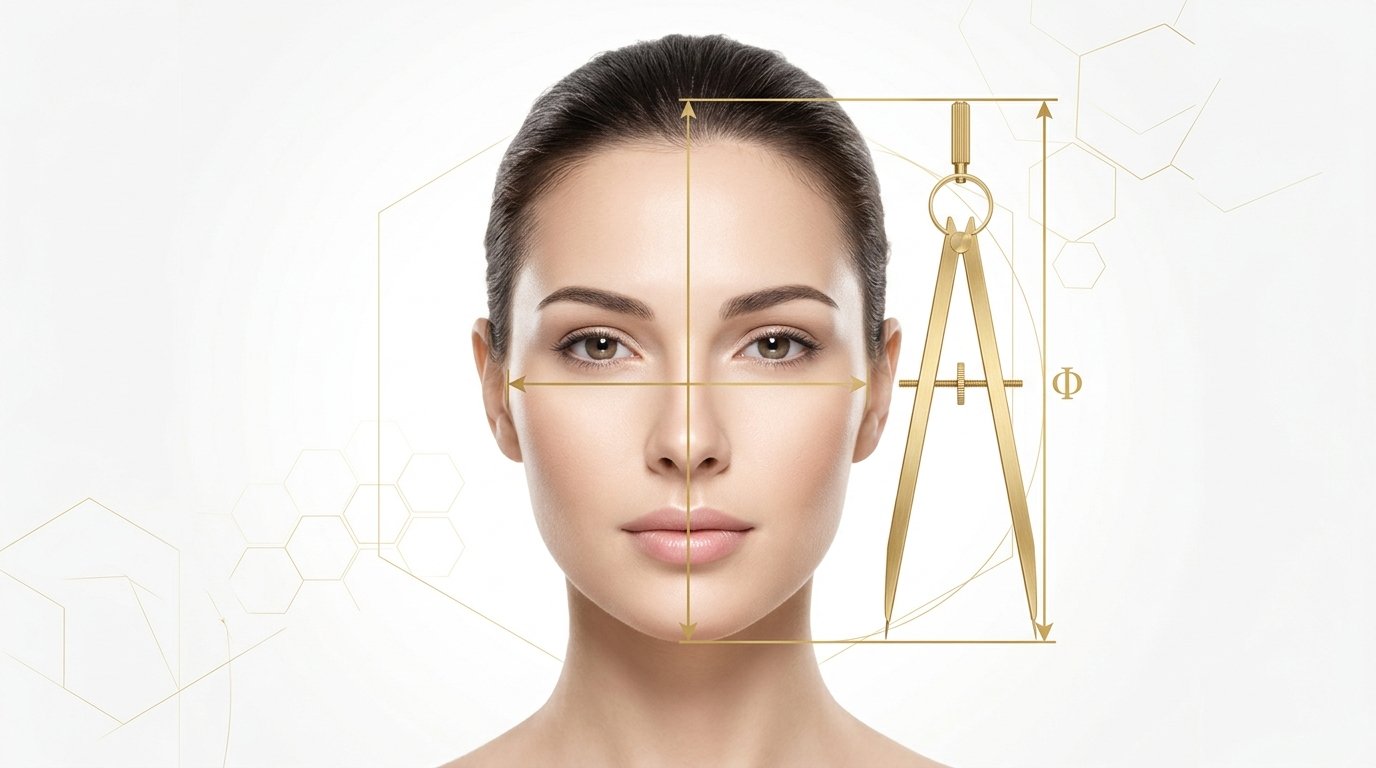
The ideal face width-to-height ratio (fWHR) is between 1.9 and 2.1. Measure your cheekbone width, divide by your upper face height (eyebrow midpoint to upper lip), and compare to the table below. The golden ratio benchmark is 1.618.
What Is the Face Width-to-Height Ratio?
The face width-to-height ratio (fWHR) is a precise measurement of facial proportions used in scientific research, cosmetic medicine, evolutionary biology, and AI-based facial analysis. It quantifies how wide your face is relative to its height — giving you a single number that encodes a surprising amount of information about your genetic blueprint, hormonal history, and even certain health signals.
The metric gained major academic attention after a landmark 2008 study by Carre and McCormick found that men with higher fWHR were consistently perceived as more dominant — even from neutral-expression photographs. Since then, over 200 peer-reviewed studies have explored fWHR connections to testosterone, leadership perception, and physical attractiveness. You can also explore your own proportions with our free Face Rater tool.
Want to find out your own facial proportions instantly? Try our free Face Rater tool — results in under 10 seconds.
How to Measure Your Face Width-to-Height Ratio
Measuring your fWHR at home is straightforward with a soft tape measure and mirror. Here is the exact method used in academic facial research:
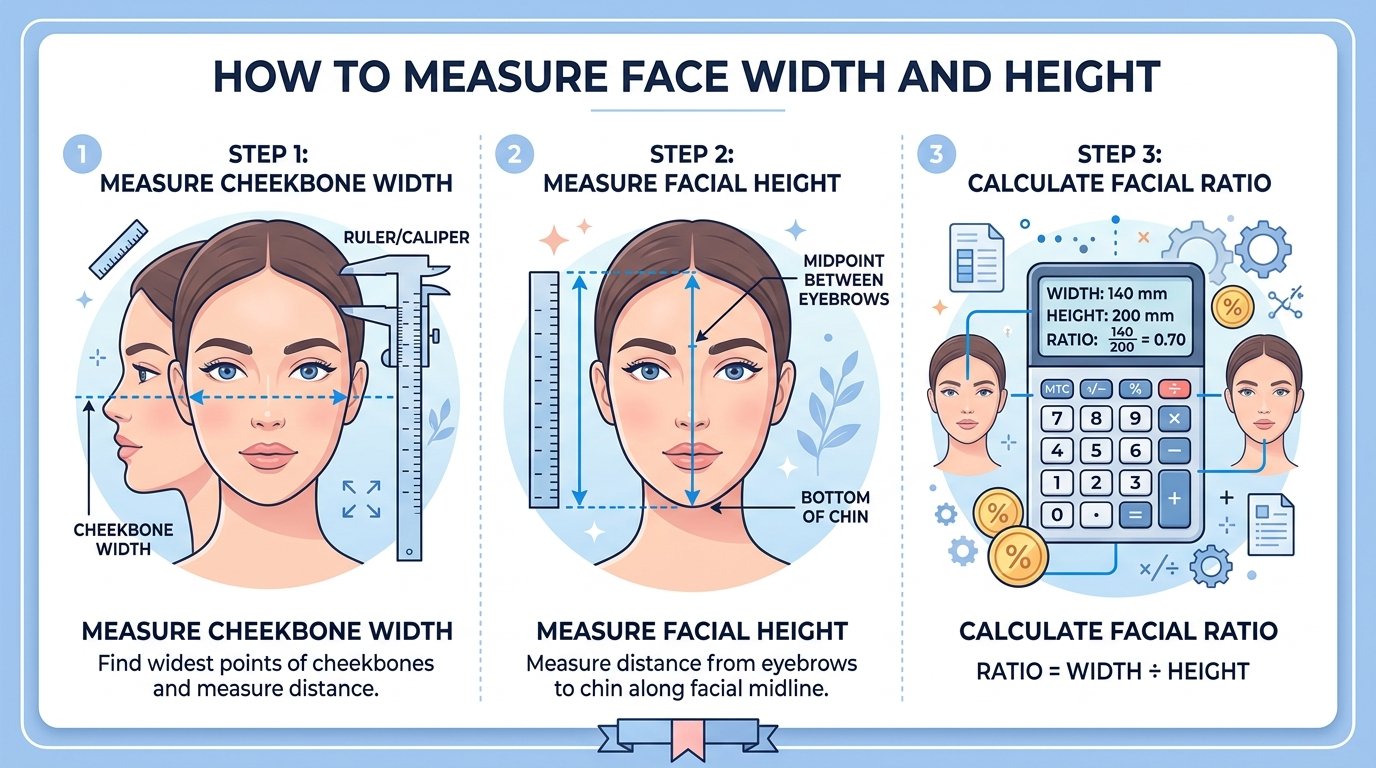
fWHR = Bizygomatic Width ÷ Upper Face Height
Bizygomatic Width: horizontal distance between the outermost edges of your cheekbones.
Upper Face Height: vertical distance from eyebrow midpoint down to the top of the upper lip.
- Measure cheekbone width: Look straight into a mirror. Place your tape measure horizontally across your face touching the outermost bony point of each cheekbone. Record in centimetres.
- Find the eyebrow midpoint: Locate the approximate centre height of your eyebrows — not the arch peak but the midpoint along the brow’s horizontal position.
- Measure upper face height: Measure vertically from that eyebrow midpoint straight down to the top edge of your upper lip.
- Calculate your fWHR: Divide your cheekbone width by your upper face height.
- Interpret your result: Use the table below to understand where you fall.
Example: Cheekbone width = 14.8 cm, upper face height = 7.4 cm. fWHR = 14.8 ÷ 7.4 = 2.0 — right in the ideal range.
What Is the Ideal Face Width-to-Height Ratio?
| fWHR Value | Face Type | Perception & Notes |
|---|---|---|
| Below 1.6 | Very long / narrow | Oblong or elongated; can appear gaunt |
| 1.6 – 1.8 | Narrow to oval | Classic oval proportions; refined and balanced |
| 1.618 | Golden ratio ideal | Mathematical beauty standard cited in aesthetic science |
| 1.9 – 2.1 | Balanced / ideal | Most frequently rated most attractive in perception studies |
| 2.1 – 2.3 | Wide / dominant | Perceived as dominant in men; strong cheekbone structure |
| Above 2.3 | Very wide face | Less common; associated with square or round shapes |
Not sure what face shape you have? Use our free Face Shape Detector to identify your shape in seconds.
Face Width-to-Height Ratio by Face Shape
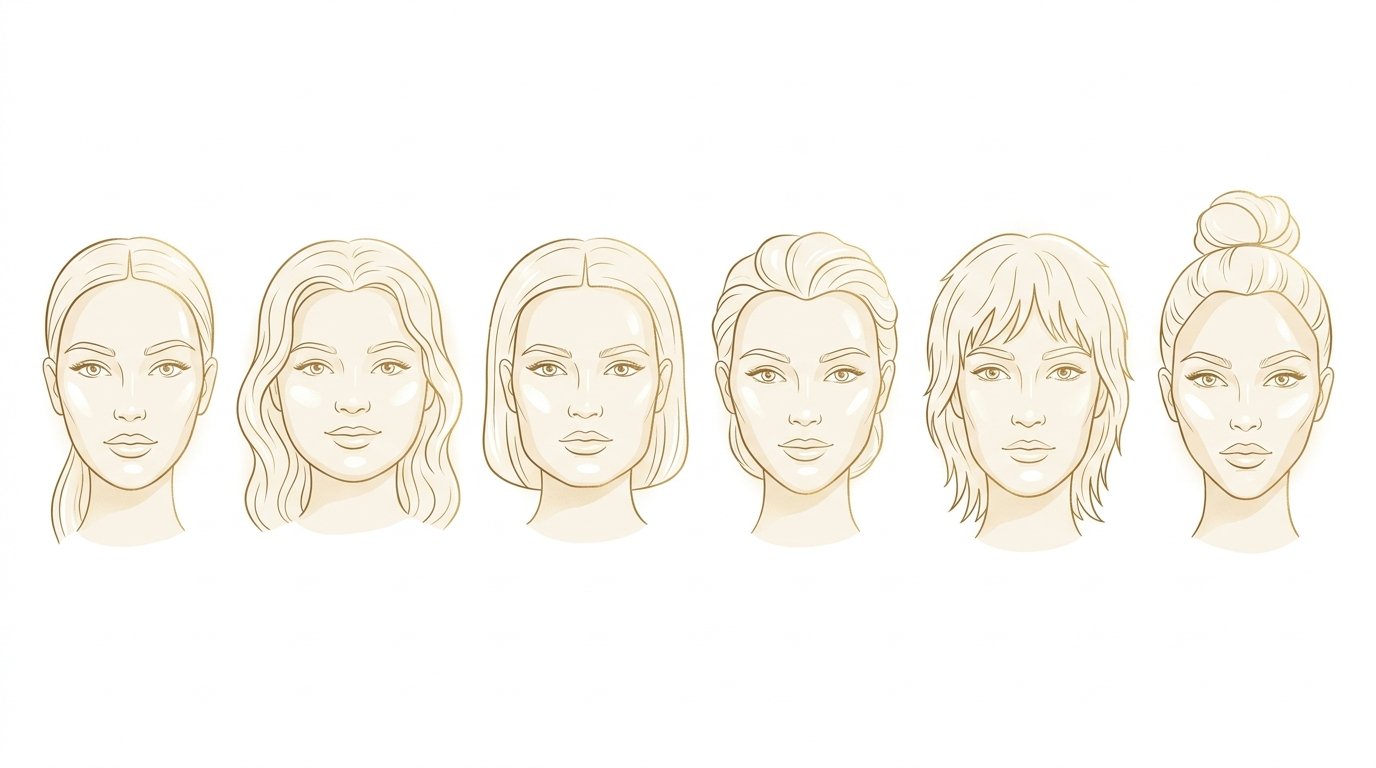
- Oval (fWHR 1.6–1.8): Gently tapered jawline, prominent cheekbones. Widely considered the most universally flattering shape.
- Round (fWHR 1.5–1.7): Nearly equal width and height — soft, youthful proportions with fuller cheeks.
- Square (fWHR 2.0–2.2): Strong angular jawline matching wide cheekbones. Projects strength and definition.
- Heart (fWHR 1.7–1.9): Broader forehead tapering to a narrow, pointed chin.
- Oblong (fWHR 1.3–1.6): Significantly more height than width — tall, narrow, uniform structure.
- Diamond (fWHR 1.8–2.0): High, wide cheekbones with narrower forehead and chin. Sits in the ideally balanced zone.
Curious how facial symmetry connects to attractiveness? Facial Symmetry Explained — Why Symmetrical Faces Are Considered Attractive.
What Does the Science Say?
The foundational 2008 Carre and McCormick study established that men with higher fWHR were consistently perceived as more dominant — replicated dozens of times across cultures. Follow-up research confirmed links between high fWHR and elevated pubertal testosterone, suggesting fWHR functions as a hormonal record imprinted on the face during skeletal development.
Multiple independent attractiveness studies rate moderate fWHR faces (roughly 1.9 to 2.1) as most attractive. Studies across North America, Europe, Asia, and Africa find broadly similar fWHR perception patterns — suggesting it reads as a biologically meaningful signal rather than a culturally specific preference.
Want to know what your face score actually means? PSL Scale Explained — Rating System, History & What Your Score Actually Tells You.
Can You Change Your Face Width-to-Height Ratio?
Your bone structure is genetically determined, but the perceived fWHR can be adjusted through styling and cosmetic techniques:
- Hairstyling: Crown volume reduces perceived width-to-height ratio. Side volume visually widens a narrow face.
- Contouring makeup: Dark contouring along temples slims perceived width. Highlighting the centre adds vertical length.
- Eyebrow architecture: A well-defined upward arch increases perceived upper face height, lowering apparent fWHR.
- Dermal fillers: Cheek fillers project the mid-face while chin fillers add vertical length, both altering perceived fWHR.
- Botox masseter reduction: Slims the jaw muscles over 3–6 months, lowering perceived fWHR in wider faces.
Want to estimate how your face age relates to your proportions? Try our free Age Guesser tool.
Frequently Asked Questions
What is the ideal face width-to-height ratio?
How do you calculate face width-to-height ratio?
What does a high face width-to-height ratio mean?
Is face width-to-height ratio attractive?
What is a normal face width-to-height ratio?
Does face width-to-height ratio differ between men and women?
Key Takeaways
- The ideal fWHR is 1.9–2.1, with 1.618 as the golden ratio benchmark
- Calculate it: bizygomatic cheekbone width ÷ upper face height
- Higher fWHR correlates with perceived dominance; moderate values correlate most with attractiveness
- Oval, round, square, diamond, heart, and oblong faces each map to specific fWHR ranges
- Hairstyling, contouring, and cosmetic procedures can all visually alter perceived fWHR