
Introduction
Have you ever looked at someone and instantly thought, "That's a beautiful face" — without being able to explain why? Chances are, facial symmetry had a lot to do with it.
Symmetry is one of the oldest and most studied factors in human attraction. From ancient sculptures carved to mathematical perfection to modern social media filters designed to "balance" your features, the human brain is wired to notice symmetry — and to reward it with attention. Our free PSL Scale Tool measures your facial symmetry as one of its core metrics, giving you a real percentage score based on landmark-point analysis.
But what exactly is facial symmetry? Why does it matter so much? And is there a way to actually test your own face for symmetry? In this article, we break down the science, the psychology, and the nuance behind why symmetrical faces are considered attractive.
What Is Facial Symmetry?
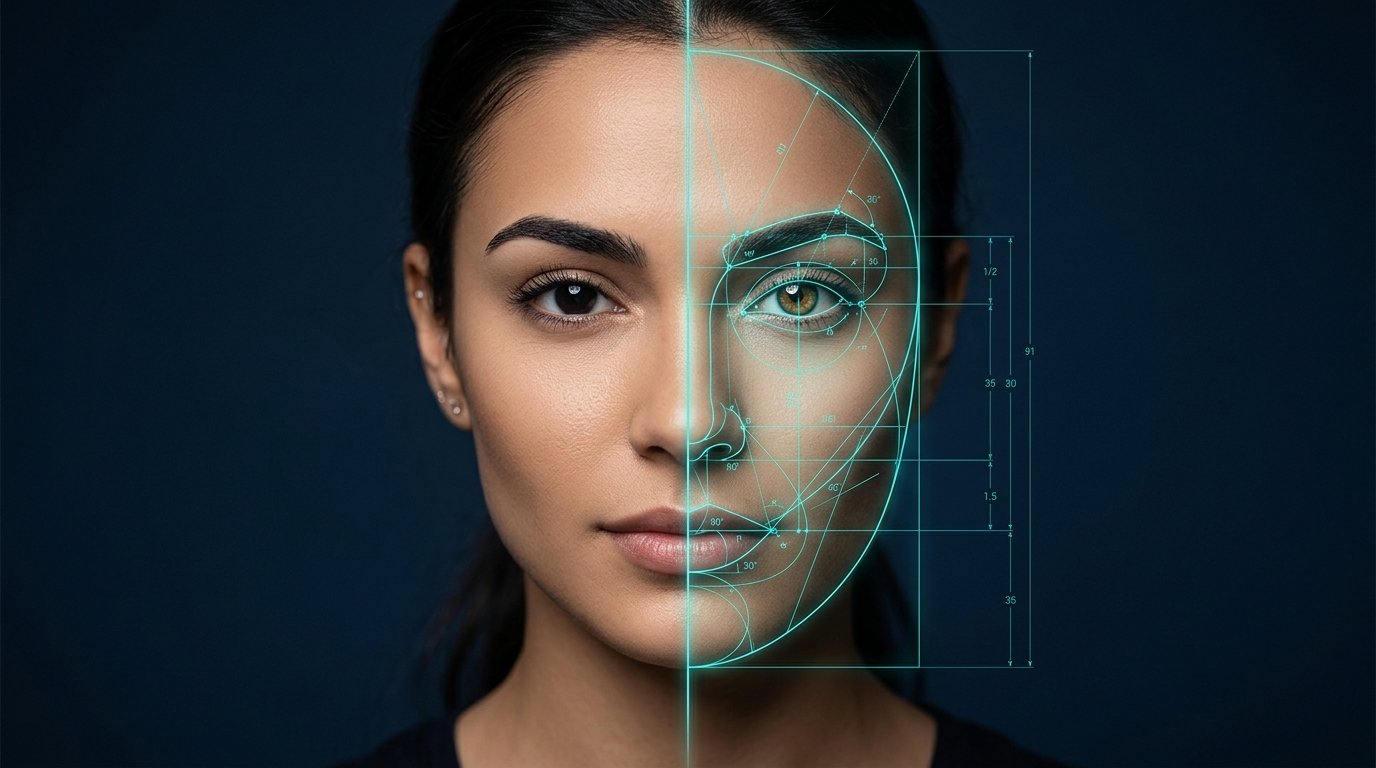
Facial symmetry refers to how closely the left and right sides of a person's face mirror each other. Imagine drawing a vertical line straight down the center of a face — from the hairline through the nose, to the chin. In a perfectly symmetrical face, each feature on the left (eye, eyebrow, cheek, nostril) would be the exact size, shape, and position as its counterpart on the right.
In reality, no human face is perfectly symmetrical. One eye may be slightly larger, one ear positioned a touch higher, or a smile might pull more strongly to one side. These differences are completely normal — and in many cases, they're part of what makes a face unique.
However, the degree of asymmetry matters. Faces with very minor, balanced differences tend to register as more attractive to observers than faces with pronounced imbalances.
Types of Facial Asymmetry
- Directional asymmetry – A consistent bias where one side is structurally larger or more developed (e.g., the jaw being slightly stronger on the dominant chewing side).
- Fluctuating asymmetry – Random, non-directional differences between left and right, which are the type most strongly linked to attractiveness research.
Fluctuating asymmetry is the one researchers focus on most, because it's believed to reflect how well a person's body coped with environmental and genetic stressors during development.
The Science Behind Facial Symmetry and Attraction
The link between facial symmetry and attractiveness isn't just cultural or subjective — it's backed by decades of scientific research.
1. Evolutionary Biology
From an evolutionary standpoint, facial symmetry is considered a marker of genetic fitness. The theory goes like this: developing a symmetrical face requires the body to maintain tight developmental control over a long period of growth. Environmental stressors — disease, malnutrition, genetic mutations, parasites — can disrupt this process and produce asymmetry.
Therefore, a more symmetrical face signals that an individual was able to resist these stressors. Subconsciously, your brain interprets symmetry as a proxy for:
- Strong immune system
- Stable genetic quality
- Overall health and vitality
This is why, according to evolutionary psychologists, humans across cultures tend to rate symmetrical faces as more attractive. It's not a learned preference — it may be deeply embedded in our biology.
2. Cognitive Processing
There's also a purely cognitive reason we're drawn to symmetry. Our brains use pattern recognition constantly, and symmetrical patterns are easier to process. When your brain encounters a symmetrical face, it takes less cognitive effort to "read" it. This processing fluency — the ease with which we perceive something — tends to generate positive feelings.
This is why symmetrical art, architecture, and even logos feel more pleasing to the eye. The brain equates "easy to process" with "good."
3. Cross-Cultural Consistency
Attractiveness standards vary enormously between cultures — body shape ideals, skin tone preferences, and fashion norms differ across societies. But facial symmetry is one of the few factors that appears consistently across cultures.
Research conducted with isolated populations (who had minimal exposure to Western media) showed similar preferences for symmetrical faces. This cross-cultural consistency strongly suggests that the preference is innate rather than socially conditioned.
What Makes an Attractive Face? (Beyond Symmetry)
While facial symmetry is important, it's just one piece of the puzzle. An attractive face combines multiple features that researchers have identified across studies.
Averageness
This might surprise you: highly average facial features — those that are close to the mathematical mean of a population — are often rated as highly attractive. This is called the "averageness hypothesis." When features are averaged, extremes disappear, and the result is a balanced, "easy to read" face.
Studies using computer-generated composite faces (where multiple faces are blended together) consistently produce images that most people find very attractive — simply because averaging smooths out any individual asymmetries or unusual proportions.
Sexual Dimorphism
Attractiveness ratings are also influenced by features associated with biological sex:
- In men: Stronger jawlines, more prominent brow ridges, and wider faces are linked to higher testosterone — and are typically rated as more masculine and attractive. Want to know how your jawline scores? Try our free PSL Scale Tool for a complete jawline and feature breakdown.
- In women: Higher cheekbones, fuller lips, larger eyes relative to face size, and smaller noses are associated with estrogen — and are typically rated as more feminine and attractive.
Skin Quality and Texture
Skin health has a powerful influence on perceived attractiveness that rivals symmetry. Clear, even-toned skin signals youth, absence of disease, and good nutrition. Even a symmetrical face with poor skin quality may be rated lower than an asymmetrical face with flawless skin.
The Golden Ratio
Some researchers and aestheticians reference the Golden Ratio (φ ≈ 1.618) as an underlying principle of facial attractiveness. The theory holds that faces closer to certain Golden Ratio proportions — the width of the face to the height, or the distance between the eyes to the width of the mouth — are rated as more attractive. Our PSL Scale Tool runs a full golden ratio test on your face and shows exactly how your proportions compare to this mathematical ideal.
How a Face Symmetry Test Works
Curious about your own facial symmetry? A face symmetry test is a method — digital or in-person — designed to measure how balanced your features are.
Digital Face Symmetry Tests
Modern AI-powered face symmetry tools work by:
- Landmark mapping – The software identifies dozens of facial landmarks (corners of the eyes, tips of the nose, corners of the mouth, edges of the jawline, etc.).
- Measurement calculation – Distances and ratios between symmetrical landmark pairs are calculated and compared left vs. right.
- Symmetry scoring – A symmetry percentage or score is generated based on how closely the two halves match.
What a Face Symmetry Test Can (and Can't) Tell You
A face symmetry test can give you a useful data point about your facial proportions, but there are important caveats:
- Lighting and angle affect results significantly. A front-facing, evenly lit photo is essential for accurate measurement.
- Scores are relative, not absolute. Even a high-symmetry score doesn't mean you're "beautiful" or a low score means you're not — attractiveness is multidimensional.
- Most people score lower than they expect. Human faces are naturally asymmetrical. The average person's face has meaningful measurable differences between sides. This is completely normal.
- 3D vs. 2D limitations. Most digital tools analyze a flat photograph, but real face symmetry is three-dimensional. A 2D photo can miss depth differences in features.
Does Symmetry Really Matter That Much?
Here's where things get nuanced. While the research on symmetry and attractiveness is robust, real-world attraction is far more complex.
The "Attractive Asymmetry" Paradox
Some asymmetric features have become iconic precisely because of their distinctiveness. Cindy Crawford's mole or Michael Jordan's slightly wider right eye didn't reduce their attractiveness — they became part of their signature look.
Researchers distinguish between objective symmetry (measurable mathematical balance) and perceived attractiveness (subjective experience). These two don't always align perfectly, because:
- Familiarity increases attractiveness (the "mere exposure" effect).
- Emotional expression matters enormously. A warm smile can make an asymmetrical face far more attractive than a neutral, highly symmetrical one.
- Personality traits are projected onto faces — confident, kind people are often rated as more physically attractive.
Self-Perception vs. Others' Perception
Interestingly, people tend to perceive their own faces as more symmetrical than they actually are. Research suggests that our familiarity with our own mirrored reflection (which is itself a flipped image of our face) contributes to this bias. Meanwhile, others may barely notice the asymmetries we obsess over in the mirror.
Curious how your face actually measures up? Try our Face Rater for a quick, objective rating — and see your symmetry score alongside your other facial metrics.
Can You Improve Facial Symmetry?
Facial symmetry is largely determined by genetics and development — but some factors are within your control.
Lifestyle Factors
- Posture: Chronic head-tilting or asymmetric chewing can subtly worsen facial asymmetry over time. Correcting posture and ensuring even jaw use can help.
- Sleep position: Consistently sleeping on one side can cause subtle tissue changes. Sleeping on your back or alternating sides may help.
- Dental health: Missing teeth, underbites, overbites, and crossbites can all create or worsen facial asymmetry. Orthodontic treatment addresses many of these.
Cosmetic Options
- Makeup contouring is one of the most accessible ways to create the appearance of greater symmetry.
- Hairstyling can frame the face to balance perceived proportions. Understanding your face shape is the first step — our Face Shape Detector can identify whether you have an oval, round, square, heart, or other face shape so you can choose the most flattering style.
- Cosmetic injectables (such as dermal fillers) are used by some to add volume to one side, address asymmetric lip fullness, or balance the cheeks.
- Surgery — in cases of significant structural asymmetry, surgical correction of the jaw, nose, or chin can produce meaningful improvements.
The Bigger Picture: Beauty Beyond Symmetry
Science confirms what most people instinctively know: beauty is not reducible to a number. Facial symmetry is one real, measurable factor in attractiveness — but it exists alongside expression, movement, personality, smell, voice, status, familiarity, and cultural context.
The most attractive people in any room aren't necessarily those with the most symmetrical faces. They're the ones who carry themselves with confidence, engage authentically, and make others feel good in their presence.
So while a face symmetry test is a fascinating window into your facial geometry, don't let a score define how you see yourself. The science of attraction is a story told in many chapters — symmetry is just one of them.
Key Takeaways
- Facial symmetry is the measure of how closely the left and right sides of a face mirror each other.
- Evolutionary biology suggests symmetry signals genetic fitness and strong immune function.
- Our brains find symmetrical patterns easier to process, which generates positive emotional responses.
- Preferences for facial symmetry are remarkably consistent across cultures, suggesting an innate basis.
- An attractive face typically combines symmetry with averageness, sexual dimorphism, and skin quality.
- A face symmetry test uses landmark mapping to measure proportional balance — but results should be interpreted with context.
- Real-world attractiveness goes far beyond symmetry, incorporating expression, personality, and social factors.