
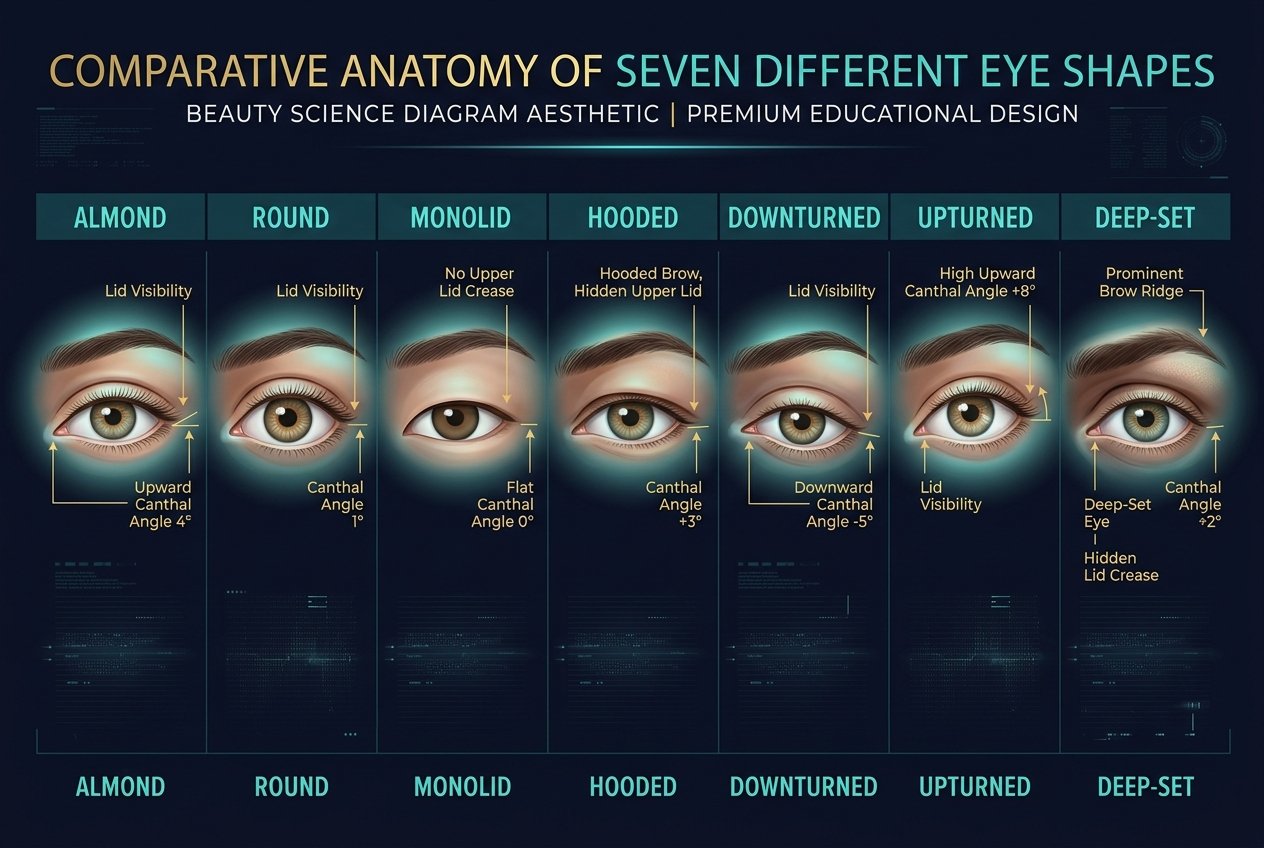
Eye shape attractiveness is driven primarily by three measurable features: canthal tilt (the angle of the outer corner relative to the inner), lid visibility (how much of the upper lid is exposed), and iris framing (how well the lid shape frames and highlights the iris). Almond and upturned eyes rank highest in attractiveness research, but every eye shape carries specific aesthetic strengths that contribute meaningfully to facial beauty.
Why Eye Shape Dominates Facial Beauty Perception
Of all the features on a human face, the eyes are processed first, fastest, and most deeply. Neuroscience research using eye-tracking technology consistently shows that observers — regardless of cultural background — fixate on the eye region within the first 100 to 200 milliseconds of viewing a face. The eyes account for a disproportionate share of attractiveness judgements, personality inferences, and emotional readings.
This is not arbitrary. The eyes are the primary channel for communicating attention, emotion, health, and reproductive fitness. Eye shape specifically influences how much of the iris and pupil is visible, how the eye appears to move during expression, and what emotional state the face projects at rest. A face with an engaging, well-shaped eye area reads as more expressive, vital, and attractive — even before any conscious evaluation happens.
Understanding eye shape attractiveness therefore is not about chasing a single ideal but about understanding which anatomical features drive positive perceptual responses and why. Our free Face Rater tool analyses your eye area geometry alongside the rest of your facial proportions for a complete, data-driven picture.
The Seven Eye Shapes: A Complete Overview
Eye shapes are classified by a combination of canthal tilt, orbital depth, lid visibility, and overall eye contour. Most people’s eyes fall primarily into one of these seven categories, though overlap is common and many faces show characteristics of two shapes.
Deep-set eyes are closely related to the hunter eye aesthetic. Read our detailed comparison: Hunter Eyes vs Almond Eyes — What is the Difference?
Almond Eyes — The Research Favourite
👁 Almond Eyes
Wider in the middle, tapering to a point at both inner and outer corners. Positive canthal tilt with the outer corner sitting visibly higher than the inner. Upper lid crease is fully visible, and the iris is well-framed without excessive scleral show above or below.
Consistently rated the most attractive eye shape across gender and cultural groups in peer-reviewed perception studies. The positive canthal tilt signals youth (it diminishes with age as soft tissue descends), and the balanced iris framing creates a face that reads as open and expressive.
- Warm, expressive, and approachable at rest
- Youthful and vibrant due to the positive tilt
- Balanced and proportional across diverse face structures
Round Eyes — Open and Expressive
◯ Round Eyes
A circular or near-circular eye contour with a large visible iris and minimal taper at the corners. The upper lid often shows a visible crease and the sclera (white of the eye) may be visible both above and below the iris at centre gaze.
Round eyes are associated with a doe-eyed, youthful, and wide-awake appearance. They score very highly for perceived innocence, openness, and vitality. Research on neotenous (youthful) facial features consistently places large, round eyes among the most powerful signals of perceived youth and fertility.
- Highly expressive and emotive — emotions read clearly
- Projects warmth and openness
- Can appear more vulnerable or sensitive
Monolid Eyes — Clean and Distinctive
⎯ Monolid Eyes
An absence of the supratarsal crease (the fold that creates the visible lid division in other eye shapes). The eyelid appears as a single, uninterrupted surface from the lash line to the brow. More common in East Asian and some Central Asian and Indigenous American populations.
Monolid eyes are widely considered striking and distinctive. They create a sleek, smooth eye contour that photographs exceptionally well. Beauty and fashion industries globally have increasingly recognised monolid eyes as a high-fashion aesthetic, with their clean geometry creating a strong visual impression.
- Calm, composed, and understated
- Clean and geometric aesthetic appeal
- Pairs powerfully with strong brow definition
Hooded Eyes — Intense and Mysterious
▩ Hooded Eyes
The brow bone or upper lid skin folds over the lid crease, partially or fully hiding it when the eye is open. The visible lid space is reduced compared to non-hooded eyes. Can appear at any age but becomes more pronounced with age as skin loses elasticity.
Hooded eyes carry a reputation for intensity and mystery that many observers find very compelling. The reduced lid space creates a more focused, penetrating gaze. When combined with a neutral or positive canthal tilt, hooded eyes are considered highly attractive in both male and female faces.
- Intense, mysterious, and confident
- Can appear more serious or brooding at rest
- Associated with artistic and intellectual aesthetics
Want to see how your eyes score within your full facial geometry? Our free Face Rater tool analyses eye area, facial symmetry, and proportions together for a complete assessment.
Downturned Eyes — Soft and Gentle
↘ Downturned Eyes
A negative canthal tilt where the outer corner of the eye sits measurably lower than the inner corner. The lower lash line slopes downward toward the outer corner, creating a gentle, drooping effect. Can appear more pronounced with age.
Downturned eyes often create an impression of softness and sensitivity that many observers find endearing. Research shows they score lower for perceived alertness and dominance but higher for perceived gentleness and approachability. Cosmetically, this eye shape has seen increased popularity in runway fashion where an intentional melancholy aesthetic is valued.
- Gentle, sensitive, and approachable at rest
- Can appear sleepy or sad without expression
- Softens an otherwise angular or sharp face beautifully
Upturned Eyes — The Fox Eye Aesthetic
↗ Upturned Eyes
A strongly positive canthal tilt where the outer corner sits notably higher than the inner corner — more pronounced than almond eyes. The outer corner appears lifted, creating the characteristic "fox eye" look. The outer portion of the lash line sweeps upward and outward.
Upturned eyes are rated among the most attractive eye shapes in contemporary perception research, particularly for female faces. The strong positive canthal tilt is associated with youthfulness, exoticism, and vitality. This aesthetic has driven the enormous popularity of the cosmetic fox-eye procedure in recent years.
- Exotic, striking, and confident
- Projects alertness and energy
- Creates a distinctive, memorable face impression
Deep-Set Eyes — Structural Intensity
👃 Deep-Set Eyes
The eye sits deeper within the orbital socket, with a more prominent brow bone projecting forward of the eyeball. This creates natural shadowing over the lid area and gives the eyes a recessed, intense appearance. Often associated with the hunter eye aesthetic.
Deep-set eyes are strongly associated with dominance, masculinity, and intensity in perception research. The brow bone shadow creates a naturally dramatic effect without any enhancement. In male faces they consistently rank among the most attractive structural configurations. In female faces, they create a distinctive, high-fashion look.
- Intense, focused, and piercing
- Projects confidence and structural strength
- Creates dramatic shadow and dimension in photographs
Canthal Tilt: The Single Most Powerful Eye Attractiveness Factor
If there is one measurement that consistently predicts eye shape attractiveness across all research, it is canthal tilt — the angle from the inner corner to the outer corner of the eye. Understanding it helps explain why some eye shapes are rated more attractive than others far more precisely than any categorical label can.
| Canthal Tilt | Associated Eye Shapes | Attractiveness Score | Personality Impression |
|---|---|---|---|
| Strongly positive (outer corner much higher) | Upturned, fox eyes | Highest overall | Exotic, energetic, confident |
| Mildly positive (outer corner slightly higher) | Almond eyes | Very high — most universally rated | Warm, balanced, expressive |
| Neutral (corners level) | Deep-set / hunter eyes | High — especially in male faces | Intense, dominant, focused |
| Negative (outer corner lower) | Downturned eyes | Moderate — scores high for softness | Gentle, sensitive, melancholy |
Eye spacing works alongside eye shape to create a complete impression. Read: How Eye Spacing Affects Facial Attractiveness — the rule of fifths and what ideal spacing looks like.
The Limbal Ring: An Overlooked Attractiveness Signal
Beyond eye shape, one of the most powerful and most overlooked contributors to eye attractiveness is the limbal ring — the dark circle that outlines the iris where it meets the whites of the eye. A visible, defined limbal ring makes the iris appear larger and the eyes appear more vivid and vital.
Research published in Psychological Science found that a darker, more defined limbal ring was consistently associated with higher attractiveness ratings and perceptions of youth and health. The limbal ring is a genuine health and youth signal — it is most pronounced in young adults, fades with age, and diminishes during illness. This makes it a biologically meaningful marker that observers are unconsciously trained to notice and respond to.
What does this mean in practice? Eye shapes that naturally frame the limbal ring more visibly — almond, round, and upturned shapes with their balanced sclera exposure — benefit from this effect more than shapes where the limbal ring is partially obscured by the lid (such as hooded eyes).
Does Eye Size Matter for Attractiveness?
Yes — but with important nuance. Research consistently shows that larger apparent eye size correlates with higher attractiveness ratings, up to a point. The association is strongest for female faces and is connected to the same neotenous (youth-associated) features that make round eyes appealing.
However, it is the apparent size — how much iris and visible eye is perceived, rather than the literal anatomical dimensions — that drives the effect. A hooded eye with a large underlying orbital opening can appear smaller than a round eye with less physical opening, purely based on how much of the eye is visible. This is why eye shape and lid visibility interact so powerfully with perceived attractiveness.
Facial symmetry plays a critical role alongside eye shape in how a face is perceived. Read our complete guide on facial symmetry — what research says and why it matters so much for beauty perception.
How Makeup Changes Eye Shape Perception
Makeup is one of the most effective tools for altering the perceived eye shape — not by changing the underlying anatomy but by directing where attention falls on the eye area.
📱 Makeup Techniques by Eye Shape Goal
- To simulate a positive canthal tilt (almond/fox eye effect): Extend eyeliner upward at the outer corner in a sharp flick. Apply darker eyeshadow to the outer third of the lid. Lift the tail of the eyebrow slightly. This is the most widely used technique for creating the appearance of a more positive canthal tilt without any procedure.
- To make eyes appear larger (round effect): Apply nude or white liner on the waterline. Use mascara heavily on upper and lower lashes. Highlight the inner corner with a light shimmer. Avoid heavy liner all the way around, which closes the eye visually.
- To open hooded eyes: Apply eyeshadow above the natural crease rather than within it — so colour remains visible when the eye is open. Tightline the upper lash line rather than drawing across the lid. A thinner, more precise liner application keeps the eye looking open.
- To soften downturned eyes: Extend liner upward at the outer corner to counteract the downward slope. Keep the lower lash line liner light or absent at the outer corner. Lift the brow tail to counterbalance the downward tilt visually.
- For monolid eyes: Use bold, graphic liner across the entire lid since the crease will not interrupt it. Dramatic cut crease makeup techniques create a defined lid structure. False lashes add definition that the crease would normally provide.
How Eye Shape Interacts with Face Shape
Eye shape does not exist independently of the face around it. The interaction between eye shape and overall face structure significantly affects how attractive the combination reads:
- Round face + almond eyes: One of the most harmonious combinations. The almond eye’s slight elongation and positive tilt complement a round face by adding visual dimension to the eye area.
- Square face + upturned eyes: The lifted outer corners of upturned eyes soften the angular jaw impression by drawing attention upward and creating a lifted facial dynamic.
- Oval face + any eye shape: The proportional balance of an oval face is genuinely flexible — all seven eye shapes read well within an oval face structure.
- Heart face + round eyes: The open, wide quality of round eyes can balance the wider forehead of a heart face by creating an expressive focal point that draws attention to the mid-face.
- Oblong face + deep-set eyes: The structural intensity of deep-set eyes works powerfully within a longer face, adding depth and dimension that breaks the vertical emphasis.
Not sure about your face shape? Use our free Face Shape Detector to identify your shape instantly — no account, no upload required.