
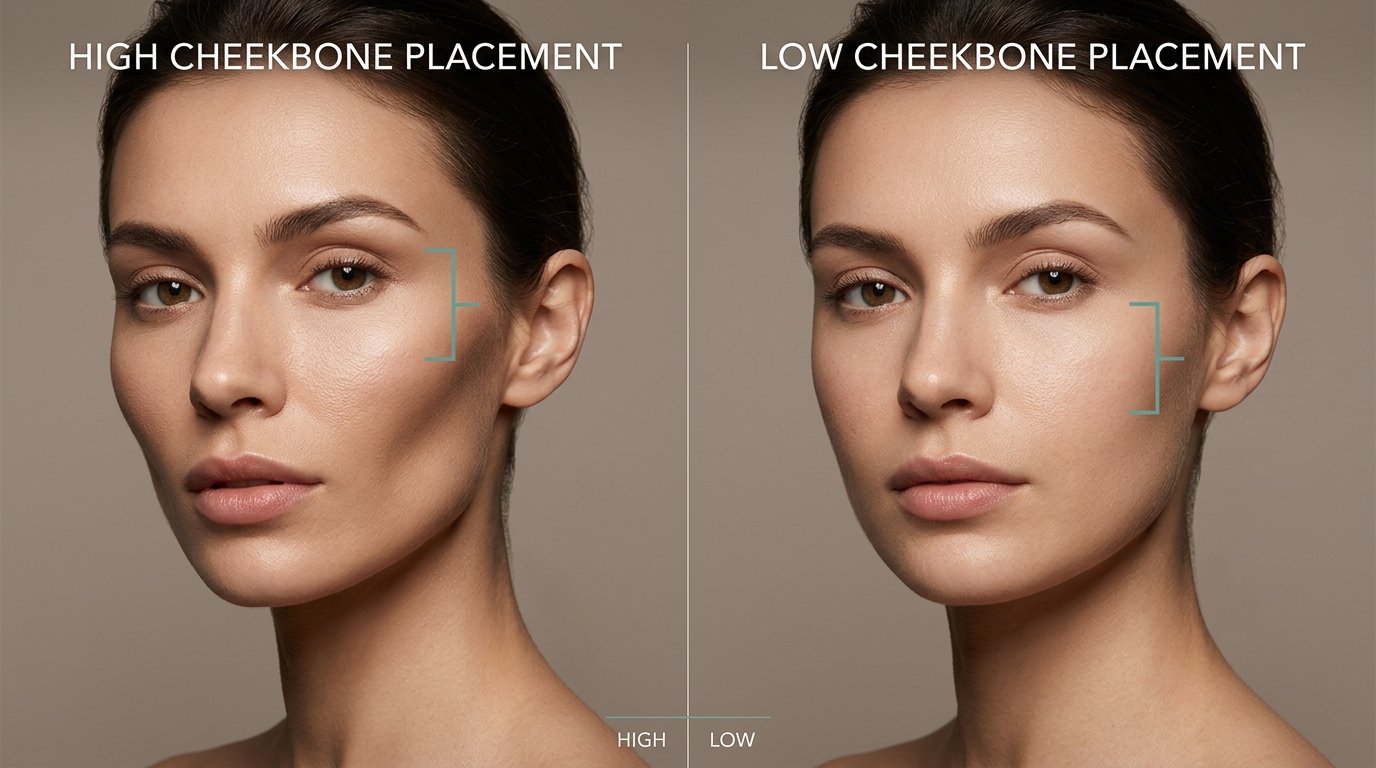
High cheekbones are cheekbones (zygomatic bones) that sit higher on the face — closer to the eye socket — and project further forward, creating a visible malar prominence with a natural highlight-and-shadow pattern on the mid-face. You have high cheekbones if: you feel a firm bony ridge close to eye level when pressing outward from the outer eye corner; good lighting creates a natural shadow below the cheekbone without makeup; and your cheekbone sits roughly level with your pupils or lower eyelid rather than near your nostrils.
What Are High Cheekbones?
The term high cheekbones refers to a specific anatomical configuration of the zygomatic bone — the bony structure that forms the cheekbone and part of the eye socket. When the zygomatic bone (and specifically its most forward-projecting point, called the malar eminence) is positioned higher on the face and projects further forward, the result is what we recognise as high cheekbones.
In practical terms, high cheekbones sit closer to the eyes than low cheekbones, and they protrude far enough from the face to create a visible ridge that catches light from above and casts a natural shadow on the lower cheek. This is the characteristic “sculpted” or “chiselled” mid-face appearance that fashion photographers, lighting directors, and makeup artists work to emphasise — because the same bone structure that creates natural shadow in person also creates the most compelling facial geometry in images.
Structurally, high cheekbones influence the face in three dimensions:
- Vertical position: How high up the face the cheekbone sits (closer to the eye = higher)
- Sagittal projection: How far forward the malar eminence projects from the facial plane
- Lateral width: How far the cheekbone extends outward, contributing to bizygomatic face width
All three dimensions contribute to whether cheekbones read as “high” — but vertical position and forward projection are the two most visually dominant. A cheekbone can be wide but not high; it can be high but not particularly projected. The most desirable cheekbone structure combines all three: high vertical position, forward projection, and moderate lateral width that gives the face its widest point in the mid-face region.
🧬 Anatomy: The Bones Behind High Cheekbones
- Zygomatic bone
- The cheekbone itself — a diamond-shaped bone forming the lateral mid-face, cheek prominence, and part of the orbital (eye socket) rim.
- Malar eminence
- The most forward-projecting point of the zygomatic bone. This is the anatomical landmark that defines how “high” and “prominent” cheekbones look in person and in photographs.
- Zygomatic arch
- The bony bridge extending from the zygomatic bone back toward the ear. Its lateral extent determines bizygomatic face width — the widest point of the face in most people.
- Malar fat pad
- A soft tissue fat compartment that sits over the malar eminence. In youth it sits high and full; with age and weight loss it descends, which can obscure or reveal underlying cheekbone structure.
- Submalar triangle
- The slight concavity directly below the malar eminence. When the malar eminence is prominent, this triangle creates the natural shadow seen below high cheekbones.
Curious how your cheekbones score in your overall facial proportion analysis? PSLScaleMe’s free Face Rater measures cheekbone prominence, face width, and mid-face structure from a single photo — free and private.
How to Tell If You Have High Cheekbones
The most reliable way to assess your own cheekbone height and prominence combines a physical touch test with a visual light test. Neither requires professional assessment — you need only a mirror and good lighting.
-
The Touch Test. Place the pads of your index fingers at the outer corners of your eyes. Slide your fingers diagonally downward and outward roughly 1.5–2cm. Press gently into the soft tissue. If you feel a firm, distinct bony ridge at or near this position — close to eye level — that is your malar eminence. Its position close to the eyes indicates high cheekbones. If the first bony ridge you feel is much lower (closer to the base of your nose), your cheekbones sit lower on the face.
-
The Light Test. Face a window with natural daylight or a single lamp angled from slightly above. Look into a mirror. High cheekbones produce a distinct natural highlight on the upper-outer cheek and a natural shadow or concavity directly below. No makeup needed — the light does the work. If you see this contrast, your cheekbones project sufficiently. A flat mid-face with little visible shadow transition indicates lower or less projected cheekbones.
-
Check the Vertical Position. In a front-facing mirror, draw an imaginary horizontal line across your face at pupil height. High cheekbones sit at or above this line. Another landmark: the outer corner of the eye (lateral canthus). If the highest point of your cheekbone sits at or above the lateral canthus level, your cheekbones are high. If the highest point sits closer to your nostril level, they are low.
-
The 3/4 Photo Test. Photograph yourself from a 45-degree angle in natural light. High cheekbones are most visible and most distinctive in the three-quarter view — the malar eminence should form a visible peak that catches the light and creates a sharp edge where it transitions to the cheek below. Compare this to the high cheekbone reference positions shown in the hero image above.
-
Look for the Under-Cheek Hollow. In lean individuals with high cheekbones, there is often a slight hollow directly below the malar eminence — the submalar triangle. This is the same area makeup artists target when contouring to simulate high cheekbones. If you naturally have this hollow without any weight loss effort, you have high and prominent cheekbones.
Note on facial fat: Elevated facial adiposity can obscure high cheekbones even when the underlying bone structure is excellent. The malar fat pad sits directly over the malar eminence — at higher body fat levels it can completely mask a structurally high and prominent cheekbone. If you are currently carrying extra facial fat, your cheekbone assessment may not reflect your underlying bone structure accurately.
High Cheekbones vs. Low Cheekbones: Key Differences
▲ High Cheekbones
- Malar eminence sits at or above pupil level
- Natural highlight-shadow pattern visible in light
- Slight hollow (submalar triangle) below cheekbone
- Creates a wide upper-mid-face, tapering toward the jaw
- Face widest point is in the mid-face (cheekbone level)
- Appears “sculpted”, angular, model-like
- Shadow created below cheekbone by projecting malar
- Visible definition in all lighting conditions
▼ Low Cheekbones
- Malar eminence sits at or below nostril level
- Less distinct light-shadow transition on cheek
- Fuller, flatter appearance in the mid-face region
- Face width appears more uniform across face levels
- Widest point may be at jaw or lower mid-face
- Appears softer, rounder, less angular
- Less natural shadow; mid-face looks fuller
- Contouring makeup has the greatest visual impact
Cheekbone position influences which face shape category you fall into. Use our free Face Shape Detector to identify your face shape — oval, heart, and diamond faces tend to have the most prominent cheekbone structures.
High Cheekbones and Attractiveness: What Research Shows
The link between high cheekbones and facial attractiveness is one of the most consistently replicated findings across cultures in empirical aesthetics. From evolutionary biology to cross-cultural rating studies, prominent cheekbones appear in virtually every list of universally attractive facial features.
The attractiveness benefit of high cheekbones operates differently in male and female faces. In female faces, prominent cheekbones are associated with oestrogen exposure — they signal femininity, healthy hormonal development, and reproductive fitness. In male faces, wide, prominent cheekbones signal testosterone and physical dominance, contributing to the “strong” masculine facial structure. This dual role across sexes explains why high cheekbones appear attractive in both male and female faces, albeit through different biological mechanisms.
From a proportional analysis perspective — the framework used by PSLScaleMe and other AI facial rating tools — cheekbone prominence contributes directly to the face width-to-height ratio (fWHR), the widest-point position of the face, and the degree of taper from cheekbone to jaw. Faces where the cheekbone represents the dominant width with a clear taper below consistently score higher in structural attractiveness metrics.
Cheekbone prominence is directly linked to your fWHR score — one of the most researched facial attractiveness metrics. Read our complete fWHR guide to understand how cheekbone width interacts with face height to produce your ratio.
Are High Cheekbones Genetic? Who Tends to Have Them?
Cheekbone structure is almost entirely genetically determined. The height, projection, and width of the zygomatic bone are heritable skeletal traits that are set during development and cannot be altered by diet, exercise, or lifestyle habits in adulthood.
| Population Group | Cheekbone Characteristics | Notes |
|---|---|---|
| East Asian | Wide, laterally prominent zygomatic arch; high malar position | High bizygomatic width creates a broad, high-cheekboned mid-face structure |
| Indigenous American | High, forward-projecting malar eminence; broad zygomatic arch | Among the highest average cheekbone prominence globally |
| Sub-Saharan African | Wide zygomatic arch; moderate malar height varies by region | Significant variation across diverse populations |
| Northern European | Variable — ranges from flat to moderately prominent malar | Celtic and Nordic populations tend toward moderate cheekbone prominence |
| Southern European / Mediterranean | Moderate-to-high malar prominence; forward projection common | Italian, Greek, and Spanish populations show higher average malar projection |
| South Asian | Variable; moderate lateral width; projection varies significantly | Significant diversity across Indian subcontinent populations |
That said, ethnicity is a broad generalisation — cheekbone structure varies enormously within populations. Individual genetics, not ethnic group membership, is the primary predictor of your specific cheekbone configuration. Facial fat coverage (see facial adiposity) and age-related changes also significantly affect how structurally prominent cheekbones present visually.
High Cheekbones and Face Shape
The position and prominence of the cheekbones are a defining feature of several face shape categories. Understanding the relationship helps you interpret your face shape in terms of underlying bone structure:
| Face Shape | Typical Cheekbone Position | Characteristic |
|---|---|---|
| Oval | High, moderately wide | Cheekbones are the widest point; face tapers symmetrically above and below |
| Heart | High, prominent | Wide cheekbones combined with a narrow chin create the heart silhouette |
| Diamond | Very high, very wide | Cheekbones are dramatically the widest point — the defining characteristic of diamond faces |
| Square | Moderate height, wide | Cheekbone width is similar to forehead and jaw width — less dramatic taper |
| Round | Lower, wider | Softer cheekbone prominence; fuller mid-face without sharp malar definition |
| Oblong / Rectangle | Variable, often moderate | Vertical length dominates; cheekbones not the primary defining feature |
Diamond and heart face shapes both feature naturally high, prominent cheekbones. Read our guide on heart vs. diamond face shapes to understand exactly how cheekbone position distinguishes these two commonly confused shapes.
How to Enhance Cheekbone Definition
Whether your cheekbones are structurally high or not, there are multiple evidence-based approaches to making them appear more prominent — from zero-cost lifestyle changes to non-surgical procedures to permanent surgical options.
Non-Invasive Methods
Reduce body fat. The most impactful non-surgical change. Lowering facial adiposity allows the malar eminence to emerge from under the overlying fat. Even 5% body fat reduction can make cheekbones dramatically more visible.
Contouring makeup. Apply matte bronzer or contour powder in the hollow below the cheekbone (submalar triangle). A light highlighter on the malar eminence itself. Together these simulate the light-and-shadow of high, prominent cheekbones even on flat mid-faces.
Hairstyle framing. Hairstyles with volume at the crown and tapered sides elongate the face and draw attention to the mid-face. Side-swept styles that clear the cheekbone area allow the bone structure to be visible rather than hidden.
Sleep quality. Poor sleep causes facial puffiness and water retention that fills the submalar hollow and obscures cheekbone definition. Consistent 7–9 hours reduces this effect noticeably within days.
Reduce sodium. High dietary sodium causes water retention in facial soft tissue, filling the cheek area and reducing cheekbone definition. Cutting processed food intake reduces this puffiness within 48–72 hours.
Lighting awareness. High, angled lighting from slightly above — common in photography and portrait lighting — dramatically enhances the appearance of cheekbone definition by creating the highlight-shadow pattern that high cheekbones produce naturally.
Non-Surgical Medical Options
- Cheek filler (malar augmentation with hyaluronic acid): Filler injected at the malar eminence adds forward projection and volume, creating the appearance of high, prominent cheekbones. 1–2 ml is typically sufficient. Results last 12–18 months. The most popular non-surgical facial procedure globally for cheekbone enhancement. Fully reversible with hyaluronidase.
- Sculptra / Radiesse: Biostimulatory fillers that add volume and stimulate collagen production. Radiesse has a firmer consistency well-suited to structural cheekbone augmentation. Results last 18–24+ months.
- PDO thread lift: Threads placed in the mid-face can elevate the malar fat pad, repositioning it to simulate the high, full cheekbone appearance. More appropriate for age-related volume descent than for adding structural prominence.
Surgical Options
- Cheek implants (malar implants): Solid silicone implants placed over the zygomatic bone through incisions inside the mouth or lower eyelid. Permanent enhancement of cheekbone projection and volume. Recovery 2–4 weeks.
- Malar fat pad repositioning (mid-face lift): Surgical elevation of the descended malar fat pad back to its youthful position over the cheekbone. More appropriate for ageing patients with good bone structure than for those lacking inherent cheekbone prominence.
In the PSL rating framework, cheekbone prominence is one of the highest-weighted female facial metrics. Read our PSL Scale for Women guide to understand how cheekbones factor into the overall female facial scoring system.
Frequently Asked Questions
What are high cheekbones exactly?
How do I check if I have high cheekbones at home?
Are high cheekbones more attractive in men or women?
Can you develop high cheekbones, or are they genetic?
Do high cheekbones make you look older?
What face shape has the most prominent high cheekbones?
Key Takeaways
- High cheekbones are zygomatic bones positioned close to the eye socket, with a malar eminence at or above pupil level that projects forward to create a visible mid-face ridge
- Identify yours with the touch test (firm ridge near eye level) and the light test (natural shadow below the cheekbone in angled light)
- High cheekbones sit at eye level; low cheekbones sit near nostril level — this vertical position is the key differentiator
- The natural submalar hollow (concavity below the cheekbone) is the most reliable visual sign of truly high, prominent cheekbones
- Research confirms cheekbone prominence as a cross-cultural attractiveness marker in both male and female faces
- Cheekbone structure is genetically determined — but facial fat, sleep, hydration, and makeup all affect how prominent they appear
- Diamond and heart face shapes are associated with the highest, most prominent cheekbone positioning
- Enhancement options range from contouring makeup and fat reduction to cheek filler and permanent silicone implants