
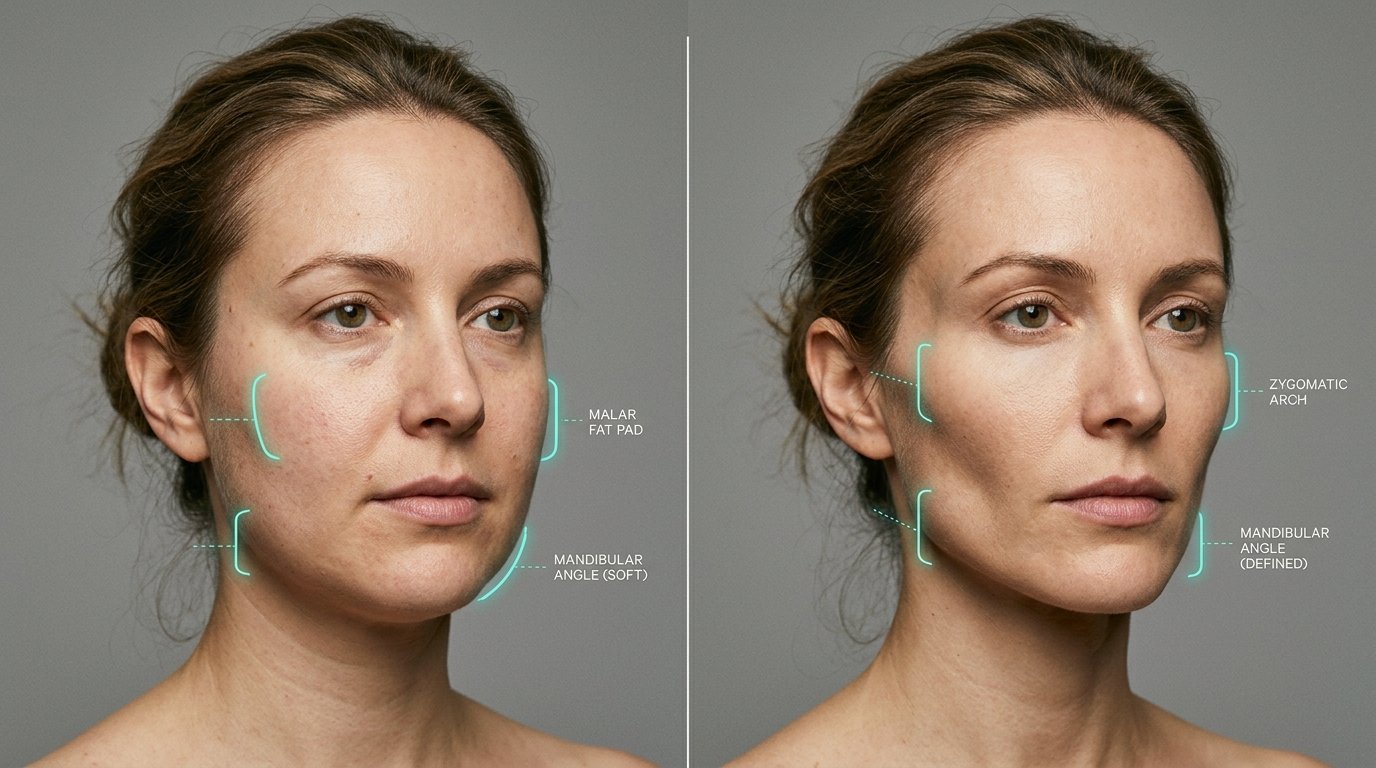
Facial adiposity is the amount and distribution of fat stored in the face. It is controlled by overall body fat percentage, genetics, cortisol levels, and age. Higher facial adiposity softens facial features and obscures bone structure; lower facial adiposity reveals cheekbone prominence, jaw definition, and facial geometry. Research shows facial adiposity is one of the strongest modifiable influences on perceived facial attractiveness.
What Is Facial Adiposity?
The term facial adiposity comes from the Latin adeps (fat) — it simply describes the quantity and spatial distribution of adipose (fat) tissue in the face. Unlike structural features such as bone shape or eye position, facial adiposity is one of the most modifiable aspects of your facial appearance. It changes with body weight, hormones, age, and lifestyle — and it has a measurable, well-researched impact on how faces are perceived.
Your face contains multiple distinct fat compartments, each sitting at different anatomical depths and responding at different rates to weight changes. Understanding where facial fat lives — and what happens when it increases or decreases — gives you a precise roadmap for understanding why your face looks the way it does and which changes will have the most visible effect on your appearance.
From an aesthetic science perspective, facial adiposity is significant because it directly modulates the key facial proportions that AI face scanners and human raters use to assess faces: cheekbone prominence, jaw definition, the face width-to-height ratio (fWHR), and overall facial geometry. When facial fat is elevated, these structural features are partially or fully obscured. When it is reduced, the face’s underlying architecture becomes the primary visual signal — for better or worse, depending on your bone structure.
Want to see how facial adiposity is affecting your own proportions right now? PSLScaleMe’s free Face Rater measures cheekbone prominence, jaw definition, and face ratio from a single photo in seconds.
The Anatomy of Facial Fat: Where It Sits
Facial fat is not uniformly distributed. It sits in discrete anatomical compartments that are separated by fibrous septa — internal walls that partition the fat into pockets. Plastic surgeons have identified approximately 12 distinct facial fat compartments across the deep and superficial layers. For appearance purposes, the most important compartments are:
Buccal Fat Pad
A large, encapsulated fat pad sitting deep in the cheek. It is the primary contributor to the “chubby cheek” appearance in higher-adiposity faces and is the target of buccal fat removal surgery. It does not disappear easily with diet alone.
Malar Fat Pad
Sits over the cheekbone (malar eminence). When full and high, it creates the appearance of prominent cheekbones. As it descends with age or fat loss, it can hollow the upper cheek and deepen the nasolabial fold.
Infraorbital Fat
Sits beneath the lower eyelid and over the orbital rim. High adiposity here creates under-eye puffiness; reduced adiposity can produce a hollow, tired appearance (“tear trough” deformity).
Jowl & Submandibular Fat
Fat below and around the jaw angle (gonion) and under the chin. This compartment most directly obscures jaw definition. Its reduction has the single largest effect on perceived jawline sharpness and overall lower-face attractiveness.
Temporal & Forehead Fat
Covers the temporal region and upper forehead. Loss here can create a sunken temple appearance common in very lean or older faces. In younger, higher-BMI faces it provides a smooth, full forehead contour.
Nasolabial & Jowl Fat
Fills the groove between the nose and corner of the mouth (nasolabial fold). Excess volume here deepens the fold and creates a “heavy” mid-face; depletion creates a gaunt appearance and deepened lines.
Key anatomy insight: Superficial facial fat (just beneath the skin) is more responsive to overall body fat changes and dietary interventions. Deep fat compartments — particularly the buccal fat pad — are more genetically fixed and respond less predictably to weight loss, which is why some people always have fuller cheeks regardless of their body weight.
The jaw angle region is where facial adiposity has the most impact on your jawline ratio. Read our full Jawline-to-Face Ratio guide to understand how your jaw measurements translate into an attractiveness score.
Facial Adiposity and Attractiveness: What Research Shows
The relationship between facial adiposity and attractiveness is one of the most robustly replicated findings in empirical aesthetics. Multiple peer-reviewed studies have quantified exactly how facial fat changes attractiveness ratings and at what threshold the change becomes perceptible to observers.
The fWHR Connection
One reason facial adiposity matters so much for attractiveness ratings is its direct effect on the face width-to-height ratio (fWHR) — one of the most heavily studied proportional metrics in facial science. Facial fat increases the apparent width of the face (by filling the cheeks and softening the jaw taper), which artificially inflates the fWHR. A face that scores poorly on fWHR due to elevated facial fat may actually have excellent underlying bone structure that becomes visible with fat loss.
Crucially, the relationship between facial adiposity and attractiveness is not simply “lower is always better.” Very low facial adiposity (BMI below ~18–19) produces a gaunt, aged appearance — hollowed temples, very prominent orbital rims, and deflated cheeks — which consistently scores poorly in attractiveness studies. The sweet spot is a moderate, healthy body fat level that allows proportional geometry to be visible without creating a skeletal appearance.
▲ Lower Facial Adiposity (Moderate)
- Cheekbones become visible and prominent
- Jaw angle sharpens and defines
- Under-chin fat reduces, extending the neck-jaw line
- Face appears narrower and more angular
- Facial geometry visible for accurate proportion scoring
- Perceived as healthier, leaner, more defined
▼ Higher Facial Adiposity
- Cheekbones obscured by soft tissue
- Jaw angle rounded and less defined
- Submental (under-chin) area enlarges
- Face appears rounder and wider
- Underlying bone structure masked
- fWHR artificially elevated by fat width
Facial adiposity directly affects your face width-to-height ratio result. Read our deep-dive on the Face Width-to-Height Ratio — what the research says, how it’s measured, and what your number means for your attractiveness profile.
Facial Adiposity as a Health Signal
Beyond aesthetics, facial adiposity is increasingly recognised in medical research as a biomarker for overall metabolic health. The face integrates adiposity signals from multiple regions, and observers have evolved to read these signals as health and immune function cues — often unconsciously.
| Health Marker | Link to Facial Adiposity | Research Basis |
|---|---|---|
| Cardiovascular health | Higher facial fat associated with higher cardiovascular risk markers (blood pressure, lipid profile) | Re & Rule (2016); Stephen et al. (2017) |
| Immune function | Lower facial adiposity correlates with stronger immune response and lower inflammatory markers | Penke et al. (2009) |
| Testosterone (male) | Lower facial fat with stronger jaw correlates with higher testosterone in male faces | Fink et al. (2005) |
| Estrogen (female) | Moderate facial fat associated with healthy estrogen — very low adiposity can signal hormonal disruption | Law Smith et al. (2006) |
| Cortisol / Stress | Chronically elevated cortisol promotes fat storage in the cheeks and submental region specifically | Pasquali et al. (2006) |
| Metabolic syndrome | Higher facial adiposity is a visible correlate of insulin resistance and metabolic syndrome | Vásárhelyi et al. (2020) |
This health-signal function explains why attractiveness judgements based on facial adiposity are not purely cultural or superficial — they appear to be evolved perceptual heuristics for detecting biological quality. Your face’s fat distribution is, in a meaningful sense, a public display of your metabolic and hormonal status.
What Controls Your Facial Adiposity?
Several factors determine how much fat your face carries and where it accumulates. Some are modifiable; others are fixed:
| Factor | Modifiable? | Effect on Facial Adiposity |
|---|---|---|
| Overall body fat % | Yes — diet & exercise | Primary driver. Reducing total body fat reduces facial fat, though genetics determine the rate |
| Genetics | No | Determines distribution pattern — some people store fat in the face first or last relative to the body |
| Cortisol (chronic stress) | Partially | Elevated cortisol drives fat storage in cheeks and submental region specifically |
| Sodium & water retention | Yes | High sodium intake causes facial puffiness and apparent adiposity via water retention |
| Age | Partially | Facial fat redistribution occurs with age — volume migrates downward, causing jowling |
| Sex hormones | Partially | Estrogen promotes mid-face volume; testosterone promotes lower-face definition. Hormonal changes shift distribution |
| Alcohol | Yes | Chronic alcohol causes facial puffiness, broken capillaries, and increased cortisol-driven fat storage |
| Sleep quality | Yes | Poor sleep raises cortisol and promotes water retention — visibly increasing apparent facial adiposity |
Facial adiposity is one of the key inputs that looksmaxxing strategies target. Read our complete Looksmaxxing guide for a structured approach to improving every modifiable aspect of your appearance — starting with the highest-ROI changes.
How to Reduce Facial Adiposity: Evidence-Based Strategies
The single most important thing to understand about reducing facial adiposity is that you cannot spot-reduce facial fat. There are no facial exercises, creams, or devices that selectively burn fat from the face. Facial fat reduction is a consequence of overall body fat reduction — and the good news is that the face is one of the first and most visible places that fat loss registers.
Non-Surgical Strategies
Caloric deficit. The only mechanism for reducing body fat, including facial fat. A moderate deficit of 400–600 kcal/day produces consistent loss without the muscle-wasting that accelerates facial ageing.
Resistance training. Preserves muscle mass during a deficit, preventing the gaunt appearance that occurs when fat and muscle are both lost. More muscle also raises resting metabolic rate.
Sleep optimisation. 7–9 hours of quality sleep reduces cortisol and facial water retention — the fastest visible change you can make to facial appearance within 48 hours.
Sodium reduction. Cutting processed food and excess salt reduces facial water retention noticeably within 2–3 days. Faces appear visibly leaner even without fat loss.
Alcohol reduction. Alcohol is both calorically dense and directly causes cortisol elevation and facial inflammation. Eliminating it is one of the fastest changes for facial appearance.
Stress management. Chronic cortisol promotes fat storage specifically in the face and submental region. Evidence-based stress reduction (mindfulness, exercise, sleep) lowers cortisol over weeks to months.
Medical & Surgical Options
For those who have reached a healthy body fat percentage but retain genetically stubborn facial fat in specific compartments, several medical interventions exist:
- Buccal fat removal (bichectomy): Surgical extraction of the buccal fat pad through small incisions inside the mouth. Permanently reduces cheek fullness and reveals more malar definition. Results are permanent and visible. Risk: over-resection can cause a prematurely gaunt appearance in later decades as natural fat loss continues with age.
- Kybella (deoxycholic acid): Injectable treatment that permanently destroys submental (under-chin) fat cells. Requires 2–4 sessions. Effective for submental fullness that persists despite low body weight.
- CoolSculpting (cryolipolysis): Non-invasive fat cell destruction via controlled cooling. Can be applied to the submental area. Results take 2–3 months to fully appear as the destroyed cells are cleared by the lymphatic system.
- Masseter Botox: Not a fat reduction, but it slims the lower face by atrophying the masseter muscle — often produces a result visually similar to reduced lower facial adiposity.
Once facial adiposity is reduced, your canthal tilt and eye shape become more visible. Read our complete Canthal Tilt guide to understand how this metric contributes to your overall attractiveness score.
How Facial Adiposity Interacts With Your Facial Proportions
Understanding facial adiposity is most useful when you connect it to the specific proportional metrics that define facial attractiveness scoring. Here is how each major metric is affected:
| Proportion Metric | Effect of Higher Adiposity | Effect of Lower Adiposity |
|---|---|---|
| fWHR | Inflated — face appears wider due to cheek fat | More accurate to bone structure; often improves toward ideal range |
| Jawline Ratio | Jaw appears less defined; ratio skews softer | Gonion points become more clearly defined; ratio tightens toward ideal |
| Cheekbone Prominence | Malar fat sits over the zygomatic arch, masking it | Zygomatic arch visible; mid-face structure apparent |
| Facial Thirds | Lower third appears fuller; chin contour less sharp | Lower third geometry cleaner; chin tip more distinct |
| Facial Symmetry | Minor asymmetries in fat distribution can increase apparent asymmetry | Bone-level symmetry revealed; symmetry score more accurate |
This is why measuring your facial proportions is most informative when done at a body weight that reflects your structural reality — ideally at or near your optimal BMI. A proportion measurement taken at high adiposity tells you about your face as it currently appears, not about the bone structure you are working with.
PSLScaleMe measures these proportions from your photo as-is, giving you a snapshot of how your face currently reads to observers and to AI. If your facial adiposity is elevated, your scores in fWHR, jaw definition, and cheekbone prominence will reflect that — making it useful as a baseline to track improvement against as you reduce body fat.
Before and after tracking your facial adiposity changes? Use our free Face Shape Detector to monitor how your perceived face shape shifts as cheekbones emerge and the jaw becomes more defined with fat loss.
Facial Adiposity and Ageing
The relationship between facial adiposity and appearance changes fundamentally with age. In youth, moderate facial fat creates smoothness and fullness that signals vitality. With ageing, facial fat does not simply disappear — it redistributes. Fat migrates downward due to gravitational pull and the degradation of retaining ligaments. The result is:
- Loss of upper mid-face volume (hollow temples, flattened cheeks)
- Accumulation in the lower face (jowls, deeper nasolabial folds, submental fullness)
- The classic “deflation from above, accumulation below” pattern that cosmetic medicine targets with volume restoration and lifting procedures
This is why the relationship between BMI and facial attractiveness is not the same at 25 as it is at 55. For older faces, some degree of facial volume is associated with a youthful appearance — reflecting the fact that age-related fat loss from the upper face is a known ageing signal. This is precisely why cosmetic providers place hyaluronic acid fillers in the temporal region and malar area of older patients, even when their body weight is healthy.
Frequently Asked Questions
What is facial adiposity?
How does facial adiposity affect attractiveness?
Can you spot-reduce facial fat?
Does losing weight always improve facial appearance?
Why do some people always have chubby faces even when lean?
How does stress affect facial adiposity?
Key Takeaways
- Facial adiposity is the amount and distribution of fat across the face’s ~12 distinct anatomical compartments
- It is one of the most modifiable influences on facial appearance — and the research confirms it significantly affects attractiveness ratings
- Observers can detect BMI changes of as little as 1 kg/m² in the face — small weight changes produce visible facial results
- The optimal attractiveness range is approximately BMI 20–22 for women and 23–24 for men — below this, faces appear gaunt
- Facial fat directly modulates your fWHR, jawline ratio, and cheekbone prominence — the core metrics in facial proportion scoring
- You cannot spot-reduce facial fat; overall body fat reduction is the primary mechanism
- Cortisol, poor sleep, high sodium, and alcohol all increase apparent facial adiposity independently of body fat percentage
- With age, facial fat redistributes downward — requiring a different strategy for appearance optimisation at different life stages