
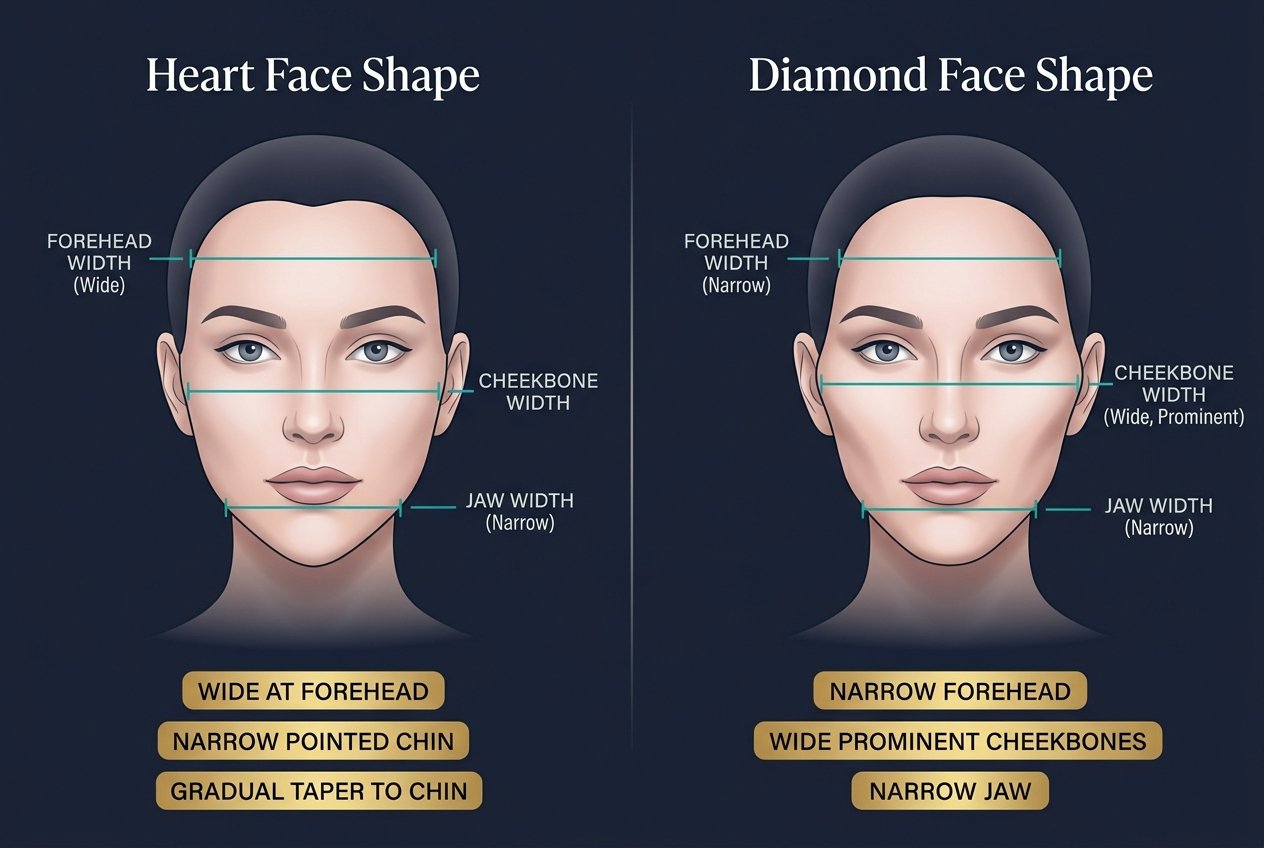
The one measurement that separates a heart face from a diamond face is the forehead width. A heart face has its widest point at the forehead. A diamond face has a narrow forehead, with the cheekbones as the clear widest point. Both shapes taper down to a narrow chin, which is exactly why they get confused so often.
Why These Two Shapes Get Confused
Heart and diamond face shapes share one very prominent feature: a narrow jaw and a pointed or narrow chin. From the jaw down, they look almost identical. That lower-face similarity is the root of the confusion.
When people try to identify their face shape by looking in the mirror, the chin draws the most attention because it is the sharpest and most distinctive point. They see a narrow chin, look up a list of face shapes with narrow chins, and land on either heart or diamond without going any further.
The critical distinction sits at the top of the face, not the bottom. Where is the widest point? Is it the forehead or the cheekbones? That single question resolves the confusion cleanly for most people.
A second reason for the confusion is that online descriptions of diamond faces often focus on the prominent cheekbones as the defining feature, while heart face descriptions focus on the wide forehead. Someone whose forehead and cheekbones are both notable relative to their jaw will find themselves reading descriptions for both shapes and recognising features in each. This is a sign they likely sit between the two shapes.
Not sure which shape you are? Our free Face Shape Detector tool gives you an instant, accurate result from a photo in seconds.
The Heart Face Shape: Full Breakdown
Core rule: The forehead is the widest point on the face. The cheekbones are moderately wide. The jaw tapers clearly to a narrow or pointed chin. The face reads as wide at the top and narrow at the bottom.
A heart face is essentially an inverted triangle. The widest measurement sits at or near the hairline, and the face narrows progressively as you move down through the cheekbones and jaw to the chin. A widow's peak hairline, a peaked hairline that forms a downward point at the centre of the forehead, is common in heart-shaped faces and adds to the inverted triangle impression.
The cheekbones in a heart face are present and often noticeable, but they are not as wide as the forehead. This is the key: in a true heart face, if you measure from hairline to hairline across the forehead and compare it to the widest cheekbone measurement, the forehead wins.
The chin is typically narrow and either softly pointed or mildly pointed. It is not sharp or angular like a square face. The jaw angles inward cleanly from the ears toward the chin without significant squaring at the corners.
The Diamond Face Shape: Full Breakdown
Core rule: The cheekbones are the widest point by a clear margin. The forehead is narrow, similar in width to the jaw. Both the forehead and jaw taper inward from the wide cheekbones, creating a four-pointed diamond silhouette.
A diamond face is defined by its cheekbones. They project outward noticeably and are wider than both the forehead and the jaw. This is what creates the four-pointed diamond shape: a narrow top, a wide middle, and a narrow bottom.
The forehead in a diamond face is relatively narrow. When you look at a diamond face straight on, the forehead does not dominate. The cheekbones do. The forehead width is typically close to the jaw width, both of which are clearly smaller than the cheekbone width.
The chin in a diamond face is often pointed, similar to a heart face. The jaw angles are sometimes slightly more defined than in a heart face because the strong cheekbones create a structural contrast that makes the narrowing from cheekbone to jaw more visually apparent.
Diamond is the rarest of the six main face shapes. Most faces that appear close to the diamond criteria end up classified as oval or heart because the cheekbone-to-forehead differential is not quite strong enough to qualify cleanly as diamond.
Read the full step-by-step measurement method in our guide: How to Identify Your Face Shape Accurately.
Heart vs Diamond: Side-by-Side Comparison
♥ Heart Face Shape
Forehead (at or near the hairline)
Broad and wide, clearly the dominant width
Present and noticeable but narrower than forehead
Tapers inward toward a narrow chin
Narrow, often softly or mildly pointed
Widow's peak common but not required
Inverted triangle, wide top to narrow bottom
Common, especially in female faces
♦ Diamond Face Shape
Cheekbones (clearly wider than both forehead and jaw)
Narrow, similar in width to the jaw
Very prominent, the defining and widest feature
Narrow, similar to forehead width
Narrow, often pointed
Usually straight or slightly curved, no widow's peak
Four-cornered diamond, wide at centre, narrow at top and bottom
Rare, the least common of the six main shapes
The Three Measurements That Settle It
You only need three measurements to tell a heart face from a diamond face with certainty:
| Measurement | Heart Face Result | Diamond Face Result |
|---|---|---|
| Forehead width | Largest of the three widths | Smaller than cheekbone width, similar to jaw |
| Cheekbone width | Second largest, less than forehead | Largest by a clear margin |
| Jaw width | Smallest, tapers to narrow chin | Narrow, similar to forehead width |
🔎 The 60-Second Home Test
- Pull your hair back completely. No hair overlapping the forehead.
- Stand facing a mirror with even lighting on both sides of your face.
- Using a soft tape measure, note: forehead width across the hairline, then cheekbone width across the prominent cheekbone points (usually at or just below the outer eye corners).
- If forehead is wider: you have a heart face shape.
- If cheekbones are clearly wider than your forehead: you have a diamond face shape.
- If forehead and cheekbones are very similar: you sit between the two shapes, or your shape is closer to oval.
What If You Fall Between Both Shapes?
Many people find that their forehead and cheekbones are close enough in width that neither heart nor diamond applies cleanly. This is the most common outcome for people who reach this comparison in the first place. They noticed the narrow jaw and chin, looked up heart and diamond, and found that both descriptions partially fit.
In practice, faces that fall between heart and diamond typically have moderately wide cheekbones and a moderately wide forehead, with neither clearly dominating. These faces often read as oval with a narrow jaw, or as heart-leaning if the forehead has any additional width advantage.
The right approach is to identify the shape you are closest to and use styling guidance for that shape. Do not try to force a clean category. The point of knowing your face shape is to make better decisions about hairstyles, glasses, and makeup, not to label yourself permanently.
Styling Differences: Heart vs Diamond
This is where the distinction actually matters. Heart and diamond faces have different structural imbalances, so the styling goal for each is different.
The goal for a heart face is to reduce the visual width of the forehead and add visual width at the jaw level. The face is top-heavy, so you want to visually balance it from the bottom up.
The goal for a diamond face is to add visual width at the forehead and soften the prominence of the cheekbones. The face is widest in the middle, so you want to bring balance to the top and bottom.
♥ Heart Face Styling
- Best hairstyles: Chin-length bobs, lobs, side-swept bangs, layered styles that add volume below the cheekbones
- Avoid: Centre parts that emphasise forehead width, voluminous styles at the crown, short styles that end at the jaw or above
- Best glasses: Bottom-heavy frames, oval frames, rimless frames that reduce the visual weight at the top of the face
- Makeup: Contour the sides of the forehead, highlight the chin and jaw to add visual width there
- Earrings: Wide, chandelier, or drop styles that draw the eye downward and visually widen the jaw area
♦ Diamond Face Styling
- Best hairstyles: Side parts with volume at the temples, curtain bangs, styles with width at the forehead level, fringe that covers the narrow forehead
- Avoid: Sleek styles pulled fully back, centre parts without any fringe, styles that add mid-face volume only
- Best glasses: Oval or cat-eye frames that add width at the top of the face, frames with detail at the top rim
- Makeup: Highlight the temples and forehead to widen the top. Contour lightly at the cheekbones to reduce their prominence
- Earrings: Studs or small hoops that do not add extra width at the cheekbone level
Get detailed hairstyle recommendations for both shapes. Read our complete guide on the best hairstyles for every face shape with specific cuts for heart and diamond faces.
Why Diamond Faces Are So Rare
Diamond is consistently listed as the rarest of the six main face shapes. The reason is geometric: the combination of a narrow forehead, clearly dominant cheekbones, and a narrow jaw all in one face requires a very specific bone structure that does not appear frequently.
Most faces that approach the diamond shape have a forehead that is wider than the strict diamond criteria require. A face with prominent cheekbones and a narrow chin but a normally wide forehead ends up classified as oval or heart rather than diamond. To qualify as diamond, the forehead must be clearly narrower than the cheekbones, which is a meaningful constraint.
This is also why many people who think they have a diamond face actually have a heart face. They have prominent cheekbones and a narrow chin, which fits both descriptions partially, but when they measure, the forehead turns out to be equal to or wider than the cheekbones, which definitively places them in the heart category.
Want a complete geometric picture of your face beyond just shape? Our free Face Rater tool analyses your proportions, symmetry, and features together in one result.