
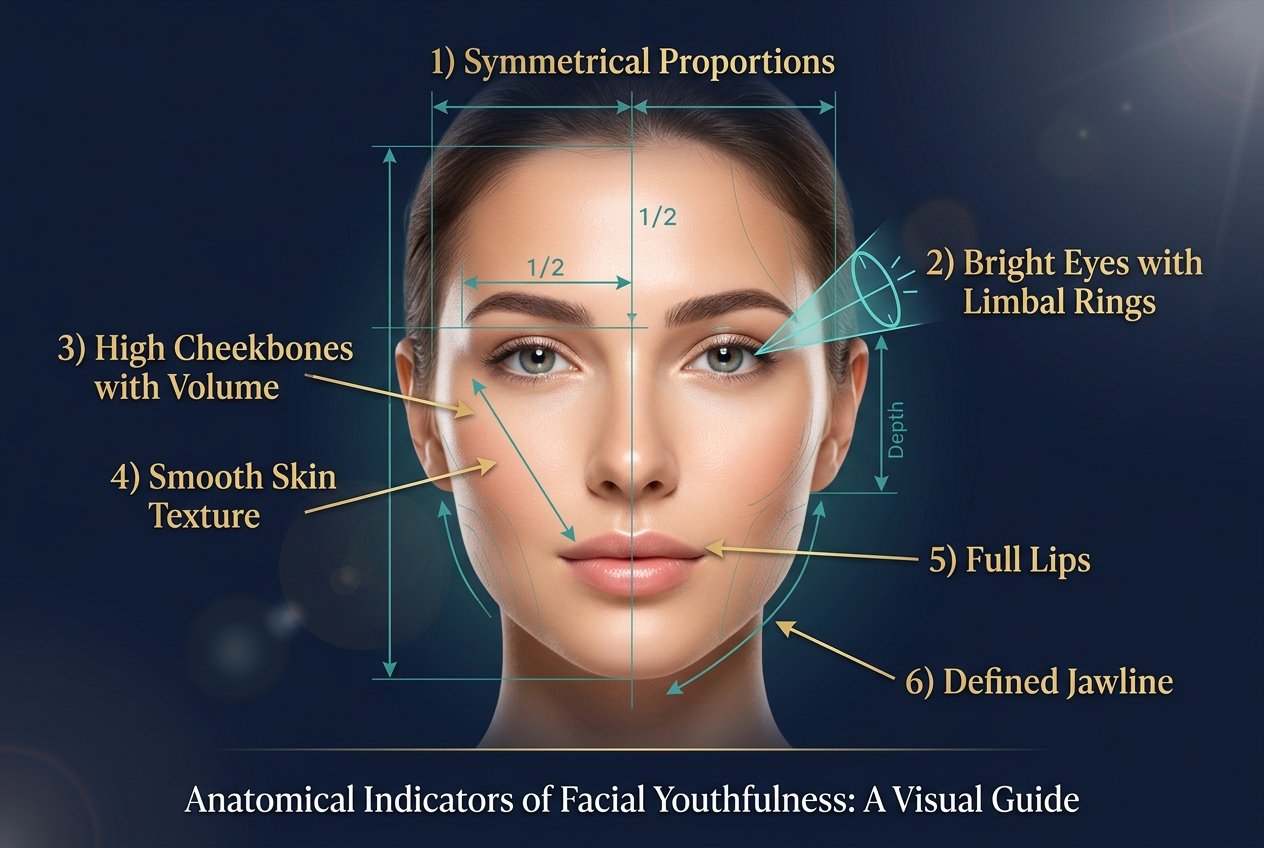
The facial features that make someone look younger are: facial volume in the cheeks and temples, a defined jawline, smooth skin texture, bright and open eyes, full lips, a positive canthal tilt, and strong facial symmetry. Of these, volume is the most powerful. A face full of volume in the right places reads as young to the human brain regardless of any individual feature in isolation.
Why the Brain Reads Age in Under a Second
Before we look at specific features, it helps to understand what the brain is actually doing when it reads someone's age. Research in social neuroscience shows the brain processes a face and estimates age within 150 milliseconds of seeing it. That is before conscious thought even engages.
What the brain is reading so fast is a set of biological signals that, throughout human evolutionary history, reliably indicated health and reproductive fitness. Youth signals like full cheeks, bright eyes, smooth skin, and a firm jawline correlate with good genes, hormonal health, and biological vitality. The brain registers these signals as attractive and young because, in evolutionary terms, they were genuinely meaningful.
This is why looking younger is not just about skin care or wrinkles. The brain is reading structure, volume, proportion, and symmetry. And each of those has specific, measurable features that either add years or take them away.
Curious how old your face actually reads to an AI? Try our free Age Guesser tool to get your apparent age estimate in seconds.
1. Facial Volume: The Biggest Youth Signal
📈 Volume in the Cheeks, Temples, and Around the Eyes
A young face is full. Not fat, but full. Volume sits high in the face: in the cheekbones, in the temples, in the periorbital area around the eyes. This creates an upside-down triangle shape, wide at the top and narrower at the jawline.
As people age, this volume drops and migrates downward. The cheeks flatten, the temples hollow, the under-eye area sinks. What was once a lifted, full mid-face starts to look deflated. The triangle flips, becoming wider at the jowl area and flatter at the cheeks.
This structural shift is the single biggest driver of looking older. It is why someone who maintains good facial volume at 50 consistently reads as 10 or 15 years younger than a person the same age who has lost significant mid-face volume. You can have perfectly smooth skin and still look significantly older if the volume beneath it is gone.
- Full, high cheekbones with volume beneath them read as young regardless of skin texture
- Hollow temples are one of the earliest and most noticeable signs of facial ageing
- Under-eye fullness (without puffiness) gives the eyes a bright, awake appearance
- Plump skin fills surface lines naturally, making texture-related ageing less visible
2. Skin Quality and Texture
🌞 Even Tone, Fine Texture, Hydration
Skin quality is one of the most immediately readable age signals on a face. Young skin has a specific set of characteristics that the brain registers almost instantly: fine pore texture, even pigmentation, a slight natural luminosity, and a hydrated, plump surface.
The absence of static wrinkles is the strongest skin youth signal. Dynamic wrinkles, the ones that appear during expression like smiling or squinting, are normal at any age. Static wrinkles, the ones visible at rest, are what the brain reads as ageing. These form as collagen breaks down and the skin loses its ability to bounce back after being compressed by facial movement.
Skin tone evenness matters more than people expect. Research on facial attractiveness consistently shows that skin with even pigmentation and uniform colour distribution is rated as significantly more youthful than skin with patchy pigmentation, sun spots, or redness, even when wrinkle depth is similar. An even tone visually fills the face and creates the impression of smoother, younger skin.
Facial proportions interact directly with how youthful a face reads. Read about the ideal face width-to-height ratio and how facial geometry shifts with age.
3. The Eye Area: Brightness, Tilt, and Openness
👀 Limbal Ring, Canthal Tilt, Under-Eye Fullness
The eyes carry more youth information than any other single facial feature. Three specific elements drive how young the eye area reads.
The limbal ring is the dark circle around the iris where it meets the white of the eye. In young adults, this ring is dark, sharp, and clearly visible, making the iris appear larger and the eyes more vivid. Research in Psychological Science found that a visible limbal ring is one of the most reliably noticed youth and health signals on the face. It fades with age and diminishes during illness, which is why it reads as such a strong signal.
Canthal tilt is the angle of the outer eye corner relative to the inner corner. A positive tilt, where the outer corner sits higher, is a genuine youth feature. This tilt is more pronounced in young faces and decreases as the soft tissue around the eye descends with age. People with a naturally maintained positive tilt at older ages consistently receive younger age estimates.
Under-eye fullness without dark circles completes the picture. Hollow, dark under-eye areas are one of the fastest ways a face reads as tired and older. The orbital fat that creates a smooth transition between the lower lid and the cheek naturally decreases with age, creating a sunken appearance that no amount of concealer fully addresses in the long term.
4. Jawline Definition
👻 A Sharp, Continuous Jaw-to-Neck Transition
A defined jawline is one of the clearest structural markers of youth on the lower face. Look at photographs of the same person across decades and the jawline change is almost always striking. Where there was once a sharp angle between the jaw and neck, there is now a softer, blurred transition.
This happens because the fat pads that sit in specific zones of the face descend over time, collecting along the jaw and creating what is commonly called jowling. The platysma muscle in the neck also loses tone, contributing to the blurred jaw-neck transition that reads so strongly as age.
People who retain strong masseter (jaw) muscle definition, maintain low facial fat, or have naturally high and prominent bone structure at the jaw consistently hold a defined jawline longer. This is why a sharp jawline at 45 is one of the most striking youth signals: it is genuinely rare and structurally meaningful.
5. Lip Fullness and a Defined Border
💕 Volume, Vermillion Border, and Lip-to-Face Ratio
Lips carry two important youth signals: volume and definition. Young lips are full and have a clearly visible vermillion border, which is the sharp edge that separates the lip from the surrounding skin. Both diminish with age.
Lip volume decreases as collagen and fat within the lips reduce. The vermillion border becomes less defined as the white roll at the lip edge flattens. Perioral lines, fine lines that radiate from the lips outward into the surrounding skin, develop as the skin loses elasticity and the orbicularis oris muscle creates repeated compression.
The lip-to-face ratio also shifts. As the mid-face elongates slightly with skeletal remodelling over time, the distance from the nose base to the upper lip border increases, making the lips appear smaller relative to the face even if their absolute size has not changed dramatically. This subtle ratio shift is read as ageing even when it is not consciously noticed.
Facial symmetry is a powerful youth signal that intersects with all of these features. Read the complete guide to facial symmetry to understand how balance and evenness affect how young and attractive a face reads.
6. Facial Symmetry
🔹 Bilateral Balance Across All Features
Symmetry is a youth signal for a specific reason: the human face becomes less symmetrical with age. Facial muscles develop asymmetrically from habitual expressions. Bone density changes unevenly. Volume loss is rarely perfectly bilateral. Even moderate asymmetry accumulates over decades.
Young faces are not perfectly symmetrical either, but they tend to have less accumulated asymmetry than older faces. The brain reads more symmetrical faces as younger because it has learned, over evolutionary time, that symmetry correlates with developmental health and genetic stability. When a face is noticeably more symmetrical than average, the brain's instinct is to read it as younger and healthier.
This is why identical twins often look visibly different in age as they get older despite sharing the same genetics. Lifestyle differences create differential asymmetry accumulation, and the more asymmetric twin consistently receives older age estimates even controlling for skin quality and wrinkles.
7. High Cheekbones with Good Projection
🔹 Bone Structure as a Long-Term Youth Advantage
High, prominent cheekbones serve two functions in terms of looking young. First, they create the kind of mid-face fullness and lift that reads as inherently youthful. Second, they provide better skeletal scaffolding for the overlying soft tissue, which means volume loss affects the face less dramatically because the underlying structure holds the tissue in a more lifted position for longer.
This is one of the reasons people with high cheekbones consistently age well in aesthetic terms. The bone structure that made their face striking at 25 continues to provide structural advantage at 55. The soft tissue may have changed, but the underlying architecture keeps the face reading as more defined and lifted than it otherwise would.
8. Skin Radiance and Colour
🌞 Luminosity, Blood Flow, and Tone
Beyond texture and wrinkles, the way skin reflects light is a meaningful youth signal. Young skin has a natural luminosity that comes from adequate hydration, healthy blood flow, and intact skin barrier function. This luminosity creates the impression of internal vitality that older skin, which reflects light more flatly, does not produce.
Skin colour also plays a role. Rosiness in the cheeks, a sign of healthy blood circulation, reads as youthful. Pallor or greyness is read as age or ill health. Research on skin colour preferences across cultures consistently finds that moderate redness and uniformity correlate with perceived youth and health far more reliably than most specific facial features do in isolation.
What Ages the Face Fastest
Understanding what makes a face look younger is only half the picture. The other half is knowing what accelerates ageing beyond the biological baseline. The research is clear on the biggest drivers:
| Factor | How It Ages the Face | Apparent Age Added |
|---|---|---|
| Chronic sun exposure | Breaks down collagen, causes pigmentation, creates texture changes, accelerates skin laxity | 3 to 10+ years |
| Smoking | Restricts blood flow, breaks down collagen faster, creates distinctive perioral lines | 5 to 10 years |
| Chronic sleep deprivation | Reduces cellular repair, creates persistent under-eye darkness, reduces skin luminosity | 2 to 5 years |
| High chronic stress | Elevates cortisol which breaks down collagen, creates tension-related expression lines | 2 to 5 years |
| Significant weight loss | Rapid volume loss from the face deflates structural fullness, the strongest short-term age accelerant | 3 to 8 years |
| Chronic dehydration | Reduces skin plumpness, makes fine lines more visible, reduces luminosity | 1 to 3 years |
Want to know how AI tools read these youth signals from a photo? Read how age guessers work to understand which facial features AI weighs most heavily when estimating age.
Can You Influence How Young Your Face Looks?
Yes, significantly. Genetics determine your baseline, but lifestyle and habits determine how far your apparent age drifts from that baseline over time. The evidence here is not speculative: twin studies that control for genetics show consistent, measurable differences in apparent age driven by behaviour.
What Actually Works for Looking Younger
- SPF use, started early and continued daily: The single most evidence-backed anti-ageing intervention. UV damage is responsible for approximately 80 percent of visible facial ageing. Daily SPF 30 or higher dramatically slows this process.
- Retinoids (retinol or prescription tretinoin): The most rigorously studied topical ingredient for reducing visible static wrinkles and improving skin texture. Takes 3 to 6 months of consistent use to show results.
- Sleep quality: During deep sleep, the body produces growth hormone and repairs cellular damage. Consistent, quality sleep maintains skin luminosity, reduces under-eye darkness, and slows the accumulation of cortisol-driven collagen breakdown.
- Facial muscle maintenance: Resistance training for the body maintains overall facial fat distribution and keeps skin looking fuller and more vital at older ages. Some evidence also supports targeted facial massage for maintaining lymphatic drainage and skin tone.
- Hydration: Internal hydration (drinking adequate water) and external hydration (moisturiser that maintains the skin barrier) both make a real difference to how fine lines and skin texture appear, particularly in photographs.
- Avoiding significant weight fluctuation: The face adapts to its fat distribution over time. Repeated significant weight loss and regain stretches skin and accelerates visible laxity far more than stable weight at a moderate level does.
Your full facial analysis goes beyond just age. Our free Face Rater tool evaluates symmetry, proportions, and facial geometry together for a complete picture of how your face reads.