
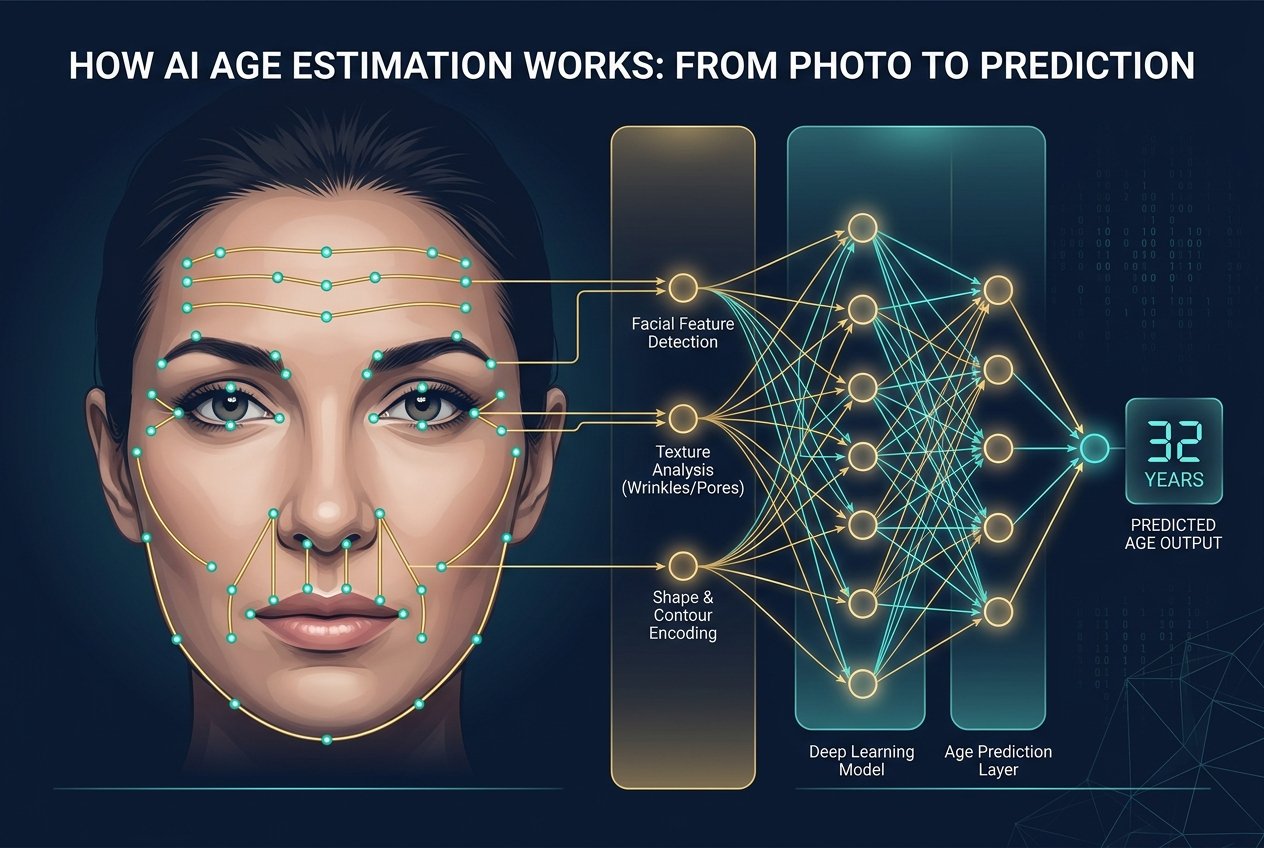
An age guesser works by running your photo through a convolutional neural network (CNN) trained on millions of labelled face images. It maps facial landmarks, analyses skin texture, wrinkle depth, facial volume distribution, and bone structure geometry, then compares these signals to patterns learned during training to predict your estimated age. Modern AI age estimators achieve 3–5 year accuracy on well-lit, frontal photos.
What Is an Age Guesser?
An age guesser — also called a photo age estimator, face age detector, or AI age predictor — is a computer vision tool that analyses a photograph of a face and returns an estimated chronological age for the person in the image. The estimate is based entirely on visible facial features, not on any personal data.
The technology is a subset of facial analysis AI, a field that grew rapidly after 2012 when deep learning models first demonstrated human-level accuracy on face recognition benchmarks. Age estimation from photos has since become one of the most researched problems in computer vision, with applications ranging from marketing analytics and security systems to medical research and — more recently — consumer curiosity tools like our free Age Guesser tool.
The core question these systems answer is this: given only what is visible on a face in a photograph, how old is this person likely to be? The answer, it turns out, is embedded in a remarkable amount of detail that the human eye notices intuitively but that AI can measure precisely.
Want to see how old your face looks right now? Try our free Age Guesser tool — results in seconds, no account needed.
How Does an AI Age Guesser Actually Work?
The process is more layered than it might first appear. A modern AI age guesser from photo typically runs through five distinct stages to produce its estimate:
-
Face detection: Before any age analysis can happen, the system must locate and isolate a face within the image. Face detection algorithms (typically based on models like MTCNN or RetinaFace) identify the bounding box around the face and reject images where no clear face is present. This step also standardises the face position for the analysis that follows.
-
Facial landmark mapping: The system then maps 68 or more precise landmark points across the face — corners of the eyes, edges of the lips, the tip and base of the nose, jawline contour points, brow midpoints, and more. These landmarks define the geometry of the face and provide reference points for subsequent feature analysis.
-
Feature extraction: The convolutional neural network analyses the image pixel-by-pixel in layers, progressively extracting increasingly abstract features. Early layers detect edges and textures. Middle layers detect structures like wrinkles and eye contours. Deeper layers detect high-level patterns like the overall balance of facial volume and the degree of skin laxity.
-
Age pattern matching: The extracted features are compared against patterns learned during training across hundreds of thousands of labelled images. The model has learned, for example, that nasolabial folds of a specific depth, combined with a specific degree of periorbital wrinkling and a specific cheek volume, corresponds to a likely age range of, say, 38 to 44.
-
Age output: The model outputs a probability distribution across age ranges, which is then summarised as a single point estimate or a range. Some models also output a confidence score reflecting how certain the estimate is — lower confidence typically indicates unusual lighting, angle, occlusion, or atypical ageing patterns.
Which Facial Features Reveal Your Age?
This is the core of how any age guesser works — understanding which visible features change predictably with age and how the AI has learned to read them.
👀 Eye Area
The skin around the eyes is among the first to show age. Crow’s feet, loss of upper lid fullness, puffiness in the under-eye area, and a gradual drooping of the outer brow are all tracked. The limbal ring — the dark circle around the iris — also fades with age and is a subtle AI signal.
🌞 Skin Texture
Younger skin has a finer texture with smaller, less visible pores. Age brings larger apparent pores, increased surface irregularity, and changes in light reflectance as collagen diminishes. AI models trained on high-resolution images are highly sensitive to these micro-texture differences.
😐 Forehead Lines
Horizontal forehead lines and vertical frown lines (the “11s” between the brows) deepen with both age and habitual expression use. They are among the most easily visible and reliably age-correlated features on the face, and AI models weight them heavily.
😄 Nasolabial Folds
The folds running from the sides of the nose to the corners of the mouth deepen significantly with age as cheek volume decreases and skin loses elasticity. Their depth and length provide a strong age signal, particularly in the 35 to 55 age range.
👻 Facial Volume
Young faces are characterised by volume fullness in the cheeks, temples, and periorbital area. This volume migrates downward and diminishes with age, producing a flatter mid-face, hollower temples, and less defined cheekbones. AI models track this volume distribution as a key age predictor.
👃 Jawline Definition
A defined, continuous jawline is a strong youth signal. With age, fat pads descend and skin laxity increases, producing jowling and a less distinct jaw-neck transition. AI measures the sharpness and continuity of the jawline as part of its age estimate.
💕 Lip Structure
Lips thin with age as collagen decreases and the vermillion border (the lip edge) becomes less defined. Perioral lines — fine lines radiating from the lips — develop progressively. The lip-to-face proportion shifts as the mid-face elongates slightly with skeletal remodelling.
💫 Pigmentation & Tone
Age spots, uneven pigmentation, and changes in skin tone evenness are all visible signals. Younger skin has more uniform colour distribution. AI models trained on colour images use pigmentation patterns as supplementary age signals alongside structural features.
Facial proportions change with age too. Read about the ideal face width-to-height ratio — and how facial geometry shifts across different life stages.
How Accurate Are Age Guessers?
Accuracy is measured using Mean Absolute Error (MAE) — the average difference in years between the AI estimate and the actual age across a test dataset. Here is how current technology performs:
| Condition | Typical MAE | Notes |
|---|---|---|
| Ideal: front-facing, good lighting, neutral expression | 2 – 3 years | Best possible accuracy range |
| Good quality selfie, natural light | 3 – 4 years | Most common real-world scenario |
| Average quality photo, slight angle | 4 – 6 years | Accuracy drops with non-frontal poses |
| Poor lighting, low resolution | 6 – 10 years | Shadows simulate wrinkles; resolution limits texture analysis |
| Heavy makeup, filters applied | 5 – 12 years | Makeup conceals age signals; filters alter texture data |
| Glasses, facial hair, hat | 5 – 8 years | Occlusions block key landmark zones |
What MAE means in practice: An MAE of 3.5 years does not mean every estimate is off by 3.5 years. It means the average error across many photos is 3.5 years. On any single photo, the estimate might be exactly right, or it might be off by 8 years — particularly if the conditions are unusual.
Chronological Age vs Biological (Facial) Age
One of the most important concepts in age estimation is the difference between chronological age and biological age. An age guesser estimates your apparent age — how old your face looks — which can differ significantly from your actual birthdate age.
Research on facial ageing consistently finds that the same chronological age can correspond to a 10 to 20 year range of apparent ages across different individuals. Some 45-year-olds look 35; some 40-year-olds look 50. The factors driving this gap are well-documented:
| Factor | Effect on Apparent Age | Strength of Effect |
|---|---|---|
| Sun exposure / UV damage | Accelerates apparent ageing significantly | Very strong |
| Smoking | Adds 5–10 apparent years on average | Very strong |
| Genetics / ethnicity | Darker skin types tend to show wrinkles later | Strong |
| Sleep quality | Chronic poor sleep visibly affects under-eye area and skin tone | Moderate to strong |
| Diet and hydration | Good hydration plumps skin, reducing apparent fine lines | Moderate |
| BMI and facial fat | Slightly higher BMI fills the face, reducing apparent age; very low BMI can age the face | Moderate |
| Stress levels | Chronic stress accelerates cortisol-driven collagen breakdown | Moderate |
| Skincare routine | SPF use and retinol significantly slow visible ageing | Moderate |
| Exercise | Regular exercise improves skin quality and maintains facial muscle tone | Moderate |
Facial symmetry is another strong youth signal that age guessers and attractiveness raters both assess. Read our complete guide to facial symmetry — what it means and why it matters.
What Makes You Look Older in a Photo?
Many people are surprised when a photo age guesser returns a higher number than they expect. The most common causes are not actual age — they are photo and condition factors that simulate ageing signals:
▲ Factors That Make You Look Older Than You Are
- Harsh overhead lighting: Creates deep shadows under the eyes and in nasolabial folds, which the AI reads as depth wrinkles.
- Dehydration: Even mild dehydration makes skin look dull, accentuates fine lines, and reduces the plumpness that signals youth.
- Tired or tense expression: Furrowed brows, squinting, and stress lines around the mouth activate ageing-associated muscle patterns.
- No makeup (when habitual): For people accustomed to wearing makeup, a bare-face photo exposes pigmentation, dark circles, and uneven tone that makeup conceals.
- High-resolution, close-up photography: Renders fine lines, pores, and texture with far greater detail than a standard selfie.
- Side lighting: Creates shadows along the nasolabial area and under the jawline, amplifying the appearance of folds and jowling.
- Downward camera angle: Shoots down the face, emphasising the jaw and neck transition and compressing the upper face.
▼ Factors That Make You Look Younger Than You Are
- Soft, even lighting from the front: Eliminates shadow simulation of wrinkles; the single most effective age-reducing photo factor.
- Slight upward camera angle: Elongates the neck and reduces jaw-neck blurring; creates a more defined, youthful silhouette.
- Relaxed, neutral or slight-smile expression: Minimises active expression lines; a forced smile actually creates more wrinkle-like creases.
- Good hydration: Visibly plumps skin and reduces the appearance of fine surface lines.
- Well-fitted makeup: Conceals pigmentation variation, evens tone, and reduces under-eye shadow signals.
- Natural hair colour that frames the face well: Warm tones around the face create a youthful, illuminated impression.
Your eye shape and area are the strongest age signals in any face. Read our guide on how eye shape affects facial beauty — including how eyes change as we age.
What Age Guessers Cannot Do
Understanding the limitations of photo age estimation is just as important as understanding how it works. There are several things even the most advanced age guesser fundamentally cannot assess:
- They cannot read genetics: The AI has no way of knowing whether someone simply has naturally slow-ageing genetics. A 55-year-old with exceptional genetics may consistently be estimated as 42 — the AI is measuring what it sees, not what it cannot see.
- They cannot account for medical history: Certain medical conditions, medications, and treatments dramatically alter apparent age. The AI has no access to this context.
- They cannot read through strong filters: Social media filters that smooth skin and brighten eyes fundamentally alter the signals the AI relies on, producing unrealistically low age estimates.
- They struggle with unusual ethnicities in training data: If the training dataset underrepresents a particular population, accuracy for that group will be lower. This is an active area of research and improvement in fair AI development.
- They cannot tell you your biological health age: A photo age guesser estimates facial apparent age only. It does not measure cardiovascular health, telomere length, or any other biological ageing marker.
The Technology Behind a Modern Age Guesser
The dominant architecture for modern photo age estimation is the Convolutional Neural Network (CNN), often combined with more recent transformer-based vision models for higher accuracy. The key technological components are:
- Training data: Large, diverse, accurately-labelled datasets (IMDB-WIKI, APPA-REAL, UTKFace) containing hundreds of thousands of face images with verified age labels provide the foundation for learning.
- Transfer learning: Most age estimation models start with a backbone network pre-trained on a much larger general image recognition task (like ImageNet), then fine-tune on facial age data. This dramatically improves accuracy on smaller age-specific datasets.
- Ordinal regression: Rather than treating age prediction as a simple classification problem, advanced models use ordinal regression, which respects the natural ordering of ages (25 is “between” 20 and 30) and produces smoother, more accurate estimates.
- Multi-task learning: Many models simultaneously learn to estimate age, gender, and ethnicity, since these tasks share useful facial feature representations. This joint learning improves accuracy on all three tasks.
- Data augmentation: Training images are artificially varied (flipped, brightened, darkened, angled) to make the model robust to real-world photo variation.
Want a complete picture of your facial features beyond age? Our free Face Rater tool analyses symmetry, proportions, and more alongside age estimation.