
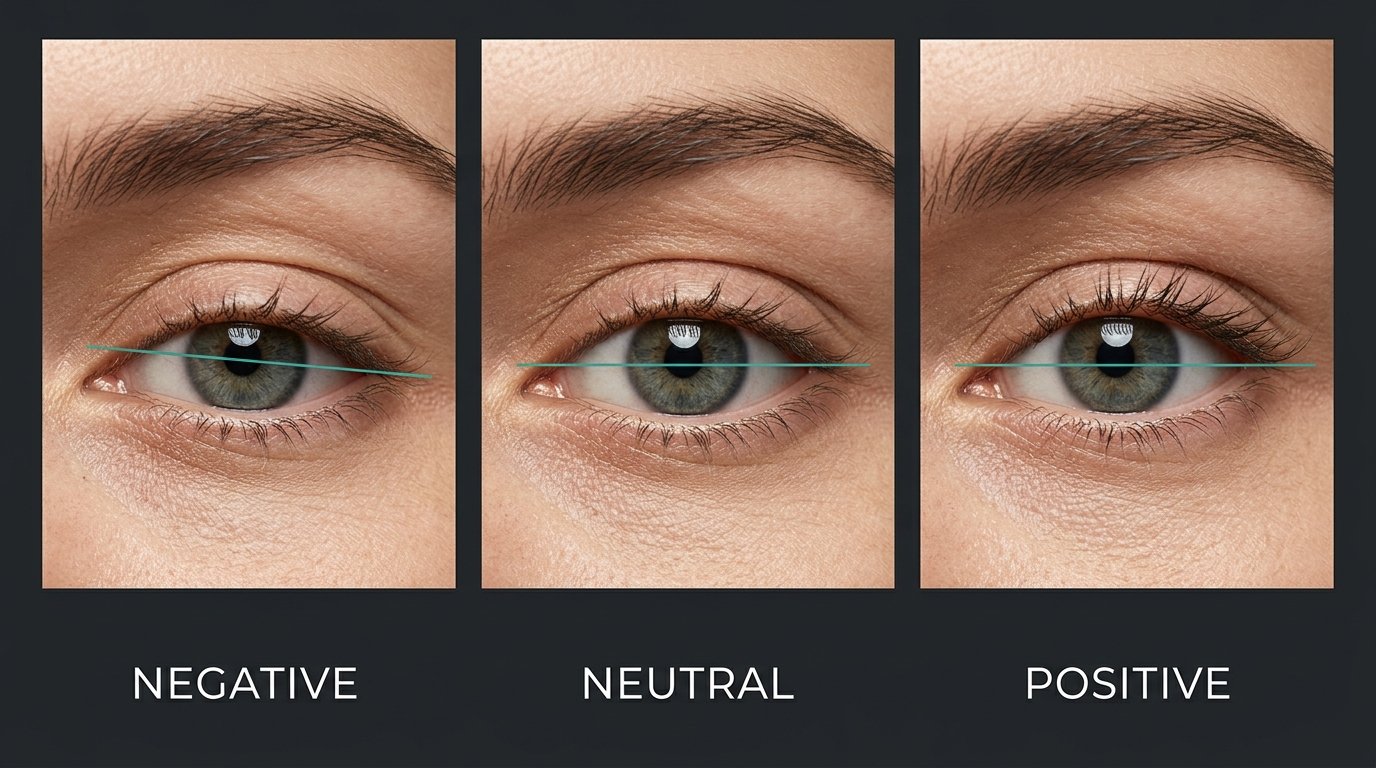
Canthal tilt is the angle between the inner and outer corners of the eye. A positive canthal tilt means the outer corner sits higher than the inner corner (upward slant). A negative canthal tilt means the outer corner sits lower (downward slant). Neutral means both corners are level. A slight positive tilt of +3 to +5° is widely considered the aesthetic ideal.
What Is Canthal Tilt?
Your eyes communicate more than emotion — their geometry carries structural information that the human brain processes almost instantly. Canthal tilt refers to the directional angle of the eye opening itself: specifically, the angle formed between the medial canthus (inner corner of the eye) and the lateral canthus (outer corner).
When you draw an imaginary line from your inner eye corner to your outer eye corner, the direction of that line — up, level, or down — defines your canthal tilt. It is one of the most discussed metrics in facial aesthetics, looksmaxxing communities, and cosmetic surgery consultations, precisely because it has an outsized influence on how the eyes — and by extension the entire face — are perceived at first glance.
Unlike many facial features that only become prominent under close scrutiny, canthal tilt is registered immediately. It shapes whether someone looks alert, intense, youthful, tired, or gentle without a single word being exchanged. Understanding your own canthal tilt angle is a meaningful step toward understanding your overall facial impression.
Want to see how your eye area scores in a full facial analysis? Try our free Face Rater tool — results in under 10 seconds.
The Three Types of Canthal Tilt
Every canthal tilt falls into one of three categories. The difference between them shapes the overall mood and perceived energy of a face far more than most people realise.
↗ Positive Canthal Tilt
The outer corner of the eye sits higher than the inner corner. The eye opening angles upward toward the temples. Associated with alertness, intensity, and youthfulness. The defining trait of “hunter eyes.”
→ Neutral Canthal Tilt
Both corners of the eye sit at the same horizontal level. The eye opening is perfectly flat. Considered balanced and harmonious — neither dramatically upward nor downward.
↘ Negative Canthal Tilt
The outer corner sits lower than the inner corner. The eye opening angles downward. Often associated with a softer, more melancholic, or tired appearance. Sometimes called “doe eyes.”
It is worth noting that neither negative nor neutral tilt is inherently unattractive — context matters enormously. Many celebrated faces carry subtle negative or neutral tilts that contribute to a soft, approachable appearance. The relationship between canthal tilt and attractiveness is real but not absolute.
How to Measure Your Canthal Tilt Angle
Measuring your own canthal tilt accurately at home requires only a straight-on photograph and a basic angle measurement tool (or a simple photo editing app). Here is the exact method used in clinical and AI-based facial assessment.
Canthal Tilt Formula: The angle between a true horizontal line (drawn from the medial canthus) and the line connecting the medial canthus to the lateral canthus.
Positive values = outer corner above horizontal | Negative values = outer corner below horizontal
- Take a straight-on photograph: Look directly into the camera lens with a completely neutral expression. The camera should be at eye level — not angled up or down. Even lighting from the front is essential; harsh side lighting casts shadows that distort perceived tilt.
- Locate your medial canthus: This is the small pinkish tear-duct area at the inner corner of each eye. Mark it on your photo.
- Locate your lateral canthus: This is the precise point where your upper and lower eyelids meet at the outer corner of the eye. Mark it on your photo.
- Draw your reference horizontal: Draw a perfectly horizontal line extending from your medial canthus outward toward the lateral canthus.
- Draw the canthal line: Draw a straight line from your medial canthus to your lateral canthus.
- Measure the angle: The angle between these two lines is your canthal tilt. Use a protractor, photo editing app, or angle measurement tool on your phone. Upward deviation = positive; downward = negative.
Your canthal tilt interacts directly with your overall face shape. Use our free Face Shape Detector to understand how your eye geometry fits your facial structure.
Canthal Tilt and Attractiveness: What Does Science Say?
The relationship between canthal tilt and attractiveness has been explored in aesthetic medicine, evolutionary biology, and cosmetic surgery literature. The consistent finding is that a slight positive canthal tilt is rated as more attractive — and the reasons run deeper than subjective taste.
Why Positive Canthal Tilt Reads as Attractive
A positive canthal tilt produces what researchers call an “alert” eye appearance. The upward angle of the eye opening mimics the natural position of younger facial tissue — before age-related descent pulls the lateral canthus downward. The brain therefore reads positive tilt as a marker of youth and vitality.
Additionally, a positive tilt is anatomically associated with a well-developed lateral orbital rim — the bony ridge at the outer edge of the eye socket. Strong orbital rims are linked to higher testosterone exposure in men, giving positively tilted eyes a subtle but measurable association with facial masculinity and dominance. This is why positive canthal tilt features heavily in PSL scoring systems as a high-value eye trait.
| Tilt Type | Angle Range | Visual Impression | Common Association |
|---|---|---|---|
| Strongly Positive | +6° and above | Intense, sharp, predatory | Hunter eyes, high masculinity |
| Mildly Positive | +3° to +5° | Alert, youthful, confident | Aesthetic ideal for both sexes |
| Neutral | Balanced, calm, harmonious | Common in oval / balanced faces | |
| Mildly Negative | −1° to −3° | Soft, approachable, gentle | Doe eyes, feminine appearance |
| Strongly Negative | −4° and below | Tired, sad, heavy-lidded | Often associated with ageing descent |
Negative Canthal Tilt in Context
It would be reductive to dismiss negative canthal tilt as universally unattractive. Several iconic and widely admired faces carry a mild negative tilt, which contributes to a softer, more approachable quality. In women especially, mildly negative tilts are often perceived as “doe-eyed” — a trait associated with innocence and femininity that ranks highly in certain attractiveness contexts.
The issue arises primarily with strongly negative tilts, particularly those caused by age-related lateral canthal descent, which signal fatigue, age, and reduced vitality — all signals the brain is wired to downrank in attractiveness assessment. The canthal tilt meaning therefore shifts depending on magnitude and context.
Canthal tilt is just one component of the full eye attractiveness picture. Read our guide comparing Hunter Eyes vs. Almond Eyes to understand how tilt interacts with eye shape and orbital structure.
How Canthal Tilt Interacts with Face Shape
Your eye canthal tilt doesn’t exist in isolation — it is read in the context of your broader facial proportions. A positive tilt on a narrow, elongated face creates a different overall impression than the same tilt on a wide, square face. Understanding how these elements interact gives you a far more nuanced picture of your facial aesthetics.
- Oval face + positive tilt: The combination is widely considered ideal — the tilt adds intensity without competing with the face’s balanced proportions.
- Square face + positive tilt: Creates a highly structured, powerful look. The sharp jaw and upward eye angle reinforce each other’s angularity.
- Round face + negative tilt: Can emphasise softness and width, making the face appear rounder. Strategic eye makeup can counteract this effectively.
- Heart face + neutral/positive tilt: Balances the broader forehead and narrows visual attention toward the centre of the face — very flattering combination.
- Diamond face + positive tilt: Reinforces the high cheekbone prominence and adds visual sharpness to an already angular structure.
How does your eye tilt connect to your overall facial symmetry score? Read our full guide on Facial Symmetry and Attractiveness — tilt asymmetry between eyes is one of the most common symmetry deviations.
Can You Change Your Canthal Tilt?
Bone structure determines the underlying orbital rim angle, which is the primary driver of natural canthal tilt. That said, both non-invasive and medical options exist for meaningfully altering the perceived or actual tilt of the eye.
Non-Invasive Approaches
- Cat-eye makeup: Extending eyeliner upward and outward from the lateral canthus is the most immediate and effective way to create the visual impression of a positive canthal tilt. This technique is used by makeup artists worldwide to create the “fox eye” or “lifted” look.
- Lash styling: Longer lashes concentrated at the outer eye corners draw attention upward and reinforce the appearance of an upward tilt.
- Brow grooming: A slightly lifted outer brow arch creates negative space above the lateral canthus, reinforcing the perception of an upward eye angle even if the tilt itself is neutral.
- Face yoga & facial exercises: While evidence is limited, targeted exercises around the orbicularis oculi muscle may help maintain tissue firmness around the outer corner over time, slowing age-related descent.
Medical & Cosmetic Options
- Lateral canthoplasty: A surgical procedure that repositions the lateral canthus upward along the orbital rim. It can convert a mildly negative tilt to neutral or positive with relatively predictable outcomes. Recovery is typically 2–4 weeks.
- Fox eye thread lift: Dissolvable PDO threads placed at the lateral canthus and temple area pull the outer eye corner upward non-surgically. Results last 12–18 months.
- Botox lateral brow lift: Strategic Botox placement to relax the muscles that pull the outer brow downward. This elevates the lateral brow, which visually raises the outer eye area and can create the impression of a more positive tilt without touching the eye itself.
- Orbital rim filler: Hyaluronic acid injected along the lateral orbital rim can add projection that reinforces the structural support of the outer eye corner, subtly improving tilt appearance.
Canthal tilt is one of the key metrics measured in the PSL Scale scoring system. Read our guide on What the PSL Scale Means to understand how eye geometry contributes to your overall score.
Canthal Tilt in PSL Scoring and Facial Rating
In facial attractiveness frameworks — including the PSL Scale used extensively in looksmaxxing communities — eye quality is one of the highest-weighted features in the upper face assessment. Within eye quality, canthal tilt is typically the single most impactful variable, weighted above iris colour, eye size, and even lash density.
A positive canthal tilt of +3 to +5 degrees is generally considered the benchmark for high eye attractiveness in both male and female assessments. pslscaleme’s face analysis engine measures your canthal tilt angle as part of its upper facial third scoring, alongside orbital rim depth, eye spacing, and overall eye symmetry. The combination of these metrics produces your eye quality component score — one of the most telling indicators of overall facial structure.
For men, a strongly positive tilt (+5 degrees or more) combined with deep-set, slightly hooded eyes is the defining characteristic of “hunter eyes” — a trait that scores near the top of male facial attractiveness hierarchies in community scoring and academic research alike. For women, a mild positive tilt (+2 to +4 degrees) with a more open, almond-shaped eye is typically rated highest.
Eye spacing also plays a critical role alongside canthal tilt. Read our guide on Eye Spacing to understand how the distance between your eyes interacts with your tilt for overall eye harmony.
Frequently Asked Questions
What is canthal tilt?
Is positive canthal tilt more attractive?
How do I measure my canthal tilt at home?
What causes negative canthal tilt?
What are hunter eyes and how do they relate to canthal tilt?
Can makeup create the appearance of positive canthal tilt?
Key Takeaways
- Canthal tilt is the angle between the inner and outer corners of the eye — positive means upward, negative means downward, neutral means level
- The aesthetic ideal is a +3 to +5 degree positive tilt for most facial types
- Positive tilt signals youth, alertness, and orbital bone strength linked to testosterone in men
- Measure it from a straight-on photo by drawing a horizontal reference from the medial canthus and measuring the deviation at the lateral canthus
- Non-surgical improvements include cat-eye liner, lash styling, and lateral brow Botox
- Surgical options include lateral canthoplasty and fox eye thread lifts for lasting results
- Canthal tilt is one of the highest-weighted eye metrics in PSL scoring and facial attractiveness research