
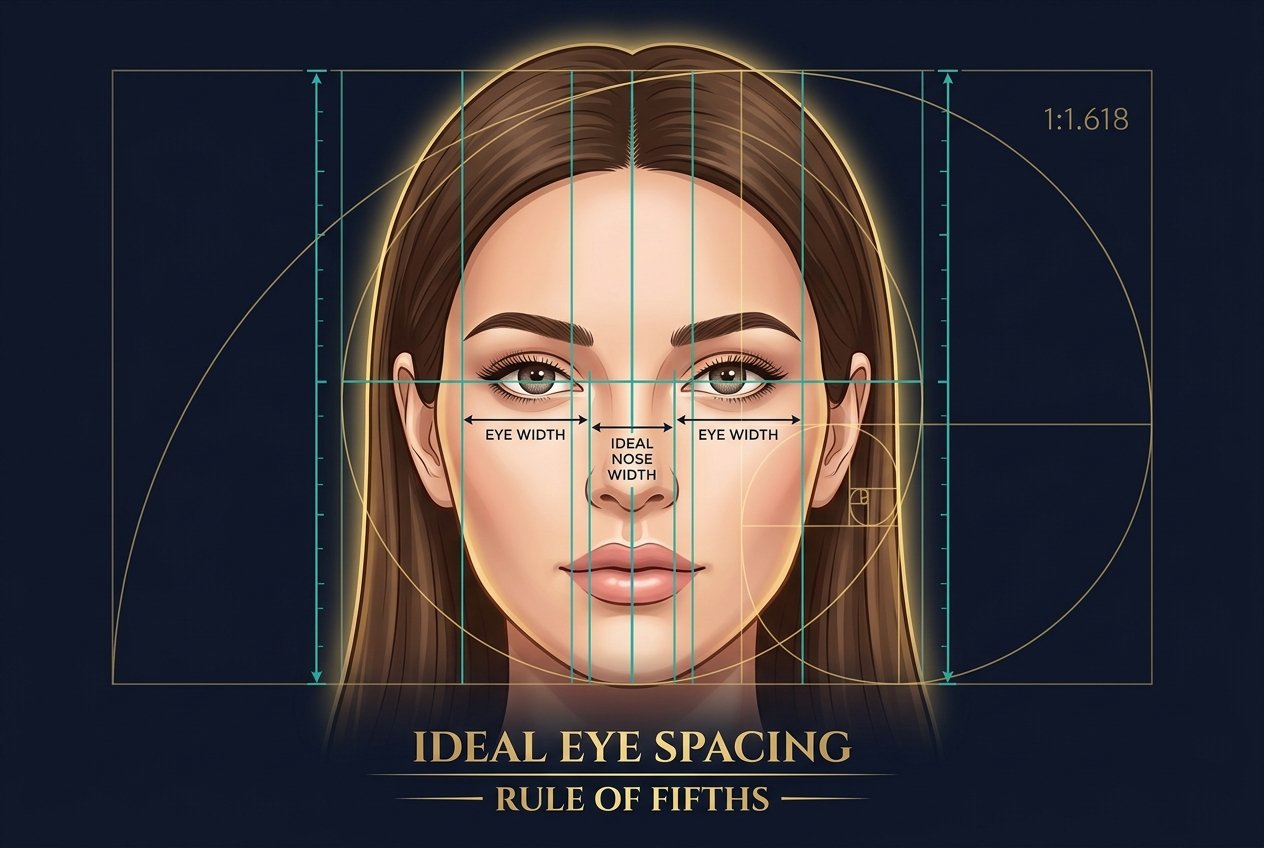
The ideal eye spacing follows the classical rule of fifths: your face width divides into five equal segments, each the width of one eye. The gap between your inner eye corners should equal exactly one eye-width. When that ratio holds, the eyes are considered proportionally spaced. Wider or narrower than that baseline creates distinctly different — but not necessarily less attractive — facial impressions.
What Is Eye Spacing and Why Does It Matter?
Eye spacing refers to the horizontal distance between your two eyes — specifically the gap between the inner corners. In clinical and research settings, two measurements define it precisely:
- Intercanthal distance (ICD): the gap from the inner corner of one eye to the inner corner of the other. This is the most commonly used eye spacing measurement.
- Interpupillary distance (IPD): the distance between the centres of each pupil. Used primarily in ophthalmology and lens prescription, but also referenced in facial proportion research.
Why does this matter for attractiveness? Because the eyes are the most information-rich zone of the human face. Research in social psychology consistently shows that the eye area is processed faster and weighted more heavily than any other facial feature during first-impression judgements. How the eyes are positioned relative to the face width — and relative to each other — fundamentally shapes how balanced, attractive, and expressive a face reads.
The classical standard for evaluating eye spacing is the rule of fifths, a proportion framework used in portrait painting, cosmetic surgery, and facial beauty research for centuries. Our free Face Rater tool applies this same geometric framework to give you a data-driven eye spacing assessment in seconds.
The Rule of Fifths: The Classical Eye Spacing Standard
The rule of fifths is one of the oldest and most widely applied frameworks in facial aesthetics. It divides the face horizontally into five equal segments, each the approximate width of one eye:
Face width ÷ 5 = one eye-width (the "fifth")
• Segment 1: outer edge of face to outer corner of left eye
• Segment 2: outer to inner corner of left eye (= one eye-width)
• Segment 3: inner left corner to inner right corner (= the intercanthal gap)
• Segment 4: outer to inner corner of right eye (= one eye-width)
• Segment 5: outer corner of right eye to outer edge of face
When all five segments are equal, the eyes are considered ideally spaced. When the middle segment (the intercanthal gap) is larger than one eye-width, the eyes are wide-set. When it is smaller, the eyes are close-set.
In practice, very few faces perfectly match the rule of fifths. But it gives researchers and clinicians a consistent mathematical baseline — which is exactly what an eye spacing calculator uses when it evaluates your proportions.
Eye spacing is one component of overall facial harmony. Read our guide on the ideal face width-to-height ratio to understand how all facial proportions connect.
How to Use an Eye Spacing Calculator at Home
You can calculate your own eye spacing ratio accurately with a soft tape measure and a well-lit mirror. Here is the exact method:
-
Measure your intercanthal distance (ICD): Look straight into the mirror with a relaxed, neutral expression. Measure the horizontal gap from your left eye’s inner corner to your right eye’s inner corner. Record in millimetres.
-
Measure one eye width: Measure from the inner corner to the outer corner of one eye (either eye). This is your single-eye width measurement.
-
Calculate your spacing ratio: Divide your ICD by your single eye width. An ideal result is 1.0. Above 1.0 indicates wide-set eyes; below 1.0 indicates close-set eyes.
-
Check against the table below to understand what your ratio means.
| ICD ÷ Eye-Width Ratio | Eye Spacing Type | Visual Impression | Frequency |
|---|---|---|---|
| Below 0.85 | Very close-set | Intense, focused, slightly narrow | Uncommon |
| 0.85 – 0.95 | Close-set | Alert, sharp, concentrated gaze | Common |
| 0.95 – 1.05 | Ideal (rule of fifths) | Balanced, harmonious, proportional | Most common |
| 1.05 – 1.20 | Wide-set | Open, exotic, welcoming | Common |
| Above 1.20 | Very wide-set | Distinctive, rare, model-like | Uncommon |
Skip the manual measuring. Our free Face Rater tool acts as a full eye spacing calculator — analysing your eye proportions, symmetry, and more in under 10 seconds.
Wide-Set Eyes vs Close-Set Eyes: Full Comparison
Wide-set and close-set eyes each create distinctly different facial impressions — and both have genuine aesthetic strengths. Neither is objectively superior; they simply read differently to observers and suit different overall face structures better.
↔ Wide-Set Eyes
- Inner eye gap larger than one eye-width
- Associated with an open, exotic, approachable look
- Common in high-fashion model faces
- Creates an impression of calm confidence
- Suits wider face structures (round, square)
- Perceived as more feminine in attractiveness research
- Makeup tip: darker inner corners bring eyes together visually
→← Close-Set Eyes
- Inner eye gap smaller than one eye-width
- Creates an intense, alert, focused expression
- Associated with intelligence and concentration
- Suits narrower face structures (oval, oblong)
- Perceived as more dominant and assertive
- Common in athletes and high-achiever portraits
- Makeup tip: outer corner focus and extended liner widen spacing
Eye type and spacing work together to shape your overall eye impression. Read: Hunter Eyes vs Almond Eyes — What is the Difference? to understand how eye shape complements spacing.
What Science Says About Eye Spacing and Attractiveness
The research on eye spacing and attractiveness is more nuanced than simple rules suggest. Here is what the published evidence actually shows:
The Deviation Penalty
Multiple studies have found that significant deviation from the rule of fifths baseline — in either direction — tends to lower attractiveness ratings slightly on average. A 2010 study by Schmid, Marx, and Samal found that facial proportions closer to the rule of fifths were consistently rated more attractive across a large, diverse sample. This does not mean the ideal is always the most attractive, but extreme deviation does carry a measurable penalty on average.
Gender Differences in Eye Spacing Perception
Research consistently identifies a gender-specific preference pattern. In female faces, slightly wider-than-ideal eye spacing (around 1.05 to 1.15 ratio) is rated more attractive by male observers in most studies, associated with perceived femininity, youth, and approachability. In male faces, narrower to ideal spacing (0.95 to 1.0 ratio) is rated higher, as it projects a more focused and dominant appearance.
Eye Spacing and Facial Symmetry
One of the most consistent findings in facial attractiveness research is that symmetry strongly predicts attractiveness ratings. Eye spacing directly affects perceived symmetry — when one eye sits measurably higher or further from the nose than the other, the spacing asymmetry is immediately noticed. Even small asymmetries in eye position (under 2mm difference) are detectable to observers and affect ratings. This is why a good eye spacing calculator evaluates both the gap between the eyes and how symmetrically each eye sits within the face.
Facial symmetry is one of the strongest predictors of attractiveness in the scientific literature. Read our complete guide to facial symmetry — what it is, how it’s measured, and what it really means for how you look.
The Role of Eye Spacing in First Impressions
Beyond attractiveness, eye spacing shapes personality impressions. Research published in the journal Perception found that wider-spaced eyes were associated with perceptions of warmth, openness, and trustworthiness. Closer-set eyes were associated with perceptions of intelligence, focus, and intensity. These associations form within the first 200 milliseconds of seeing a face — before any conscious evaluation takes place.
This matters practically. In professional and social contexts, the impressions created by eye spacing are real, measurable, and consistently replicated across cultures. Understanding your own eye spacing helps you make informed choices about makeup, hairstyling, and photography angles.
How to Change the Appearance of Your Eye Spacing
Your bone structure determines your actual eye spacing, but the perceived spacing is remarkably adjustable through several techniques:
📱 Makeup Techniques by Eye Spacing Type
- For wide-set eyes — draw attention inward: Apply a deeper shade of eyeshadow from the inner corner outward to the mid-lid. Extend your brow starting point slightly inward (closer to the nose bridge). Nude or light inner corner highlight can be avoided, as it emphasises the gap.
- For close-set eyes — draw attention outward: Concentrate darker eyeshadow on the outer two-thirds of the lid. Extend eyeliner beyond the outer corner in a slight flick. Start brows a hair-width further from the nose than your natural starting point. Highlight the inner corner with a light shimmer shade to open and widen the visible space.
- For both — brow architecture matters: The arch position, starting point, and tail length of your brows all influence where the eyes appear to sit. A brow starting point closer to the nose pulls eyes together; starting further out pushes them apart.
Photography and Lighting
Camera angle has a significant effect on perceived eye spacing. Shooting from slightly above creates a mild foreshortening effect that can make wide-set eyes appear slightly closer. A straight-on shot at eye level gives the most accurate representation of actual spacing. Three-quarter angles (turning the face slightly left or right) tend to minimise the apparent size of the space between the eyes on the side facing away from camera.
Hairstyle Choices
Hairstyles that create fullness at the temples — soft waves, curtain bangs, face-framing layers — can visually narrow the apparent width between the eyes by drawing attention to the outer face rather than the centre. Centre parts with no fringe can sometimes emphasise wide spacing by creating a direct vertical line that highlights the horizontal gap between the eyes.
Want to know which hairstyle suits your overall face structure? Use our free Face Shape Detector — then read our guide on the best hairstyles for every face shape.
How Eye Spacing Fits Into the Bigger Picture
Eye spacing never exists in isolation — it interacts with the surrounding facial geometry to create an overall impression. The most important relationships are:
- Eye spacing and nose width: The width of the nose base ideally equals the intercanthal distance (the inner-eye gap). When both measurements match, the central face block feels proportional.
- Eye spacing and face width: A wider face (higher face width-to-height ratio) tends to make the same absolute eye spacing look less wide, because there is more face surrounding the eyes. A narrower face makes the same spacing look wider by comparison.
- Eye spacing and brow height: Eyes that sit closer together are more noticeable when the brows are also close to the eyes, compressing the upper face. Lifting the brow tail can reduce this effect.
- Eye spacing and canthal tilt: Wide-set eyes with a positive canthal tilt (outer corner higher) create a distinctive exotic appearance that scores very high in attractiveness research. The combination is rarer than either feature alone.