
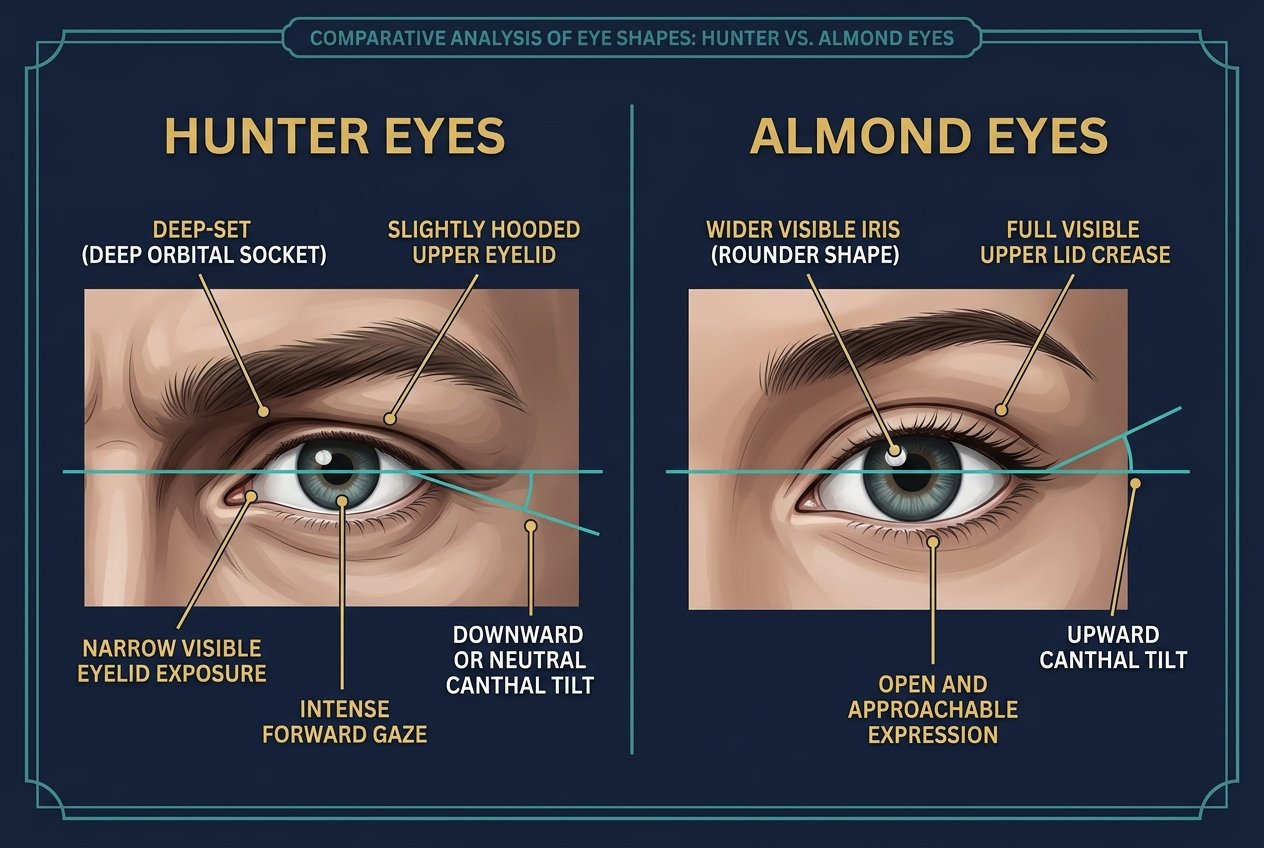
Hunter eyes have a deep orbital setting, neutral to negative canthal tilt, and narrower lid exposure — creating an intense, sharp, forward-facing expression. Almond eyes have a positive canthal tilt (outer corner higher than inner), a wider visible iris, and a fuller upper lid crease giving a more open, warm appearance. The core difference comes down to three measurable anatomical features.
Why Eye Shape Gets So Much Attention
Eye shape is one of the most powerful elements of facial perception. Research consistently shows the eye area accounts for a disproportionately large share of how we judge attractiveness, age, emotional state, and personality on first impression — often more than the nose, mouth, or jaw.
So the distinction between hunter eyes and almond eyes is not just internet aesthetics jargon. It reflects genuinely different anatomical configurations that trigger different perceptual responses in observers.
Want a full breakdown of your facial features? Try our free Face Rater — AI-powered analysis in under 10 seconds.
The Key Concept: Canthal Tilt
Before comparing the two eye types, you need to understand one measurement that defines both: canthal tilt. This is the angle from the inner corner of the eye (medial canthus) to the outer corner (lateral canthus).
| Canthal Tilt Type | Outer Corner Position | Visual Effect | Associated With |
|---|---|---|---|
| Positive | Higher than inner corner | Lifted, youthful, open | Almond eyes, fox eyes |
| Neutral / Zero | Level with inner corner | Sharp, intense, direct | Hunter eyes |
| Negative | Lower than inner corner | Droopy, tired, soft | Downturned eyes |
Hunter eyes typically show a neutral or very slightly negative canthal tilt. Almond eyes show a clear positive canthal tilt — the outer corner sits measurably higher than the inner — giving a lifted, slightly exotic appearance.
Eye geometry connects directly to overall facial proportions. Read: What Is the Ideal Face Width-to-Height Ratio — how facial measurements affect perceived attractiveness.
What Are Hunter Eyes? A Full Definition
The term hunter eyes comes from the analogy of a predator’s gaze — eyes set deeply forward in the skull, slightly hooded, projecting a sense of focused intensity. The anatomy behind it is well documented.
The Four Defining Features of Hunter Eyes
1. Deep orbital setting. Hunter eyes sit deeper within the eye socket. The brow bone protrudes forward of the eyeball, creating natural shadowing over the lid area and a recessed, intense look even with a neutral expression.
2. Neutral or slightly negative canthal tilt. The outer corner sits at or marginally below the level of the inner corner — the feature most responsible for the sharp, level gaze that defines the hunter eye appearance.
3. Smaller visible lid exposure. Because the brow bone protrudes and orbital setting is deep, less of the upper eyelid is visible. This hooded quality concentrates the apparent intensity of the eye.
4. Forward-projecting midface. Hunter eyes typically accompany well-developed cheekbones, which adds to the overall sense of structural definition.
🔴 Hunter Eyes — Key Traits
- Deep-set within the orbital socket
- Neutral to slightly negative canthal tilt
- Prominent brow bone projection
- Semi-hooded or narrower lid visibility
- Intense, direct, sharp expression
- Often paired with high cheekbones
- Common in strong masculine facial structures
🟢 Almond Eyes — Key Traits
- Moderate orbital depth, not deep-set
- Positive canthal tilt (outer corner higher)
- Fuller visible upper lid crease
- Wider visible iris and white of eye
- Open, warm, approachable expression
- Works equally on all face structures
- Common across East Asian and mixed heritage faces
What Are Almond Eyes? A Full Definition
Almond eyes get their name from the almond nut — wider in the middle and tapering to a point at both corners. The key distinction from hunter eyes is not just the shape outline but the specific geometric relationship between the corners.
In true almond eyes, the outer corner sits visibly higher than the inner corner, creating a natural lifted effect. The iris is well-framed by the lid shape, with neither the upper nor lower white of the eye showing excessively. Almond eyes are often described as the most universally flattering eye shape because the positive canthal tilt and balanced proportions complement almost every face structure.
The simplest test: Draw an imaginary line from your inner corner to your outer corner. If the outer corner sits above the line — positive tilt, almond/fox eye territory. If it sits level — neutral tilt, hunter eye territory. If it sits below — negative tilt, downturned eyes.
Eye shape connects closely to facial symmetry perception. Read: Facial Symmetry Explained — Why Symmetrical Faces Are Considered Attractive.
Side-by-Side Comparison
| Feature | Hunter Eyes | Almond Eyes |
|---|---|---|
| Canthal tilt | Neutral (0) or slightly negative | Positive (outer corner higher) |
| Orbital depth | Deep-set, recessed | Moderate, not prominently deep |
| Lid visibility | Narrower, semi-hooded | Fuller, visible crease |
| Sclera exposure | Minimal visible white | Balanced, iris well-framed |
| Brow bone | Prominent, projects forward | Less pronounced projection |
| Default expression | Intense, serious, sharp | Open, warm, approachable |
| Perceived gender lean | Strong masculine association | Works across all genders equally |
| Perceived age | Can appear older, more serious | Associated with youth and vitality |
| Rarity | Relatively uncommon | More common globally |
What Science Actually Says
The attractiveness research on eye shape is more nuanced than most online discussions suggest. Studies generally find that both hunter eyes and almond eyes are rated above average for attractiveness — but for markedly different reasons and often by different observers.
What Attracts Observers to Hunter Eyes
Multiple studies have linked deep-set, hooded eyes with perceptions of dominance, assertiveness, and high testosterone. Research on male facial attractiveness consistently places strong orbital structure — prominent brow bone, deep-set eyes, defined periorbital area — among the top structural predictors of perceived masculinity. This association likely has evolutionary roots: deep orbital structure correlates with developmental testosterone exposure.
What Attracts Observers to Almond Eyes
Almond eyes consistently score highest for overall attractiveness across gender groups in perception studies. The positive canthal tilt is associated with youth — both because it diminishes with age as soft tissue descends, and because it is more pronounced in younger faces. Research on female facial attractiveness in particular consistently identifies positive canthal tilt as a strongly preferred feature.
Your eye shape is one part of your overall facial geometry. Use our free Face Shape Detector to get a complete picture of your facial structure.
Can You Change Your Eye Shape?
Non-Surgical Approaches
Makeup and contouring. This is the most effective non-surgical method. A well-executed eyeliner flick extending from the outer corner upward can simulate a positive canthal tilt. These techniques produce immediate results that are genuinely convincing.
Mewing and tongue posture. Correct tongue posture may have subtle effects on midface development in growing adolescents. In fully developed adults, the effect, if any, is very subtle. It will not significantly transform your eye shape.
Body fat. Periorbital fat significantly influences how deep-set eyes appear. Lower body fat makes eyes appear more deep-set and hunter-like. This is a real and noticeable effect in many people.
Cosmetic Procedures
Canthopexy and canthoplasty. These surgical procedures reposition the lateral canthus to create a positive tilt. The most direct surgical route to almond-eye aesthetics. Results are permanent.
Fox eye thread lift. A minimally invasive procedure using barbed threads to lift the outer corner. Results last 12 to 18 months on average.
Brow bone reduction / augmentation. Reducing brow bone prominence softens the hooded effect of hunter eyes. Augmenting it increases prominence for a more defined orbital structure.
🚫 Common Myths About Eye Shape
- Myth: Hunter eyes are always more attractive. Science does not support this. Both score highly, for different attributes and with different observer demographics.
- Myth: Almond eyes are the same as fox eyes. Fox eyes specifically require an elongated outer corner. Almond eyes have a more rounded, full shape. Similar but not identical.
- Myth: You can get hunter eyes permanently through mewing alone. Mewing may have subtle effects in adolescence but will not significantly restructure the orbital area in adults.
- Myth: Only certain ethnicities can have hunter eyes. Hunter eye structure appears across all ethnic groups. It is a feature of bone structure, not ethnicity.
Eye shape is one of many features analysed in facial attractiveness research. Read our PSL Scale guide to understand how online beauty rating systems approach these metrics.