
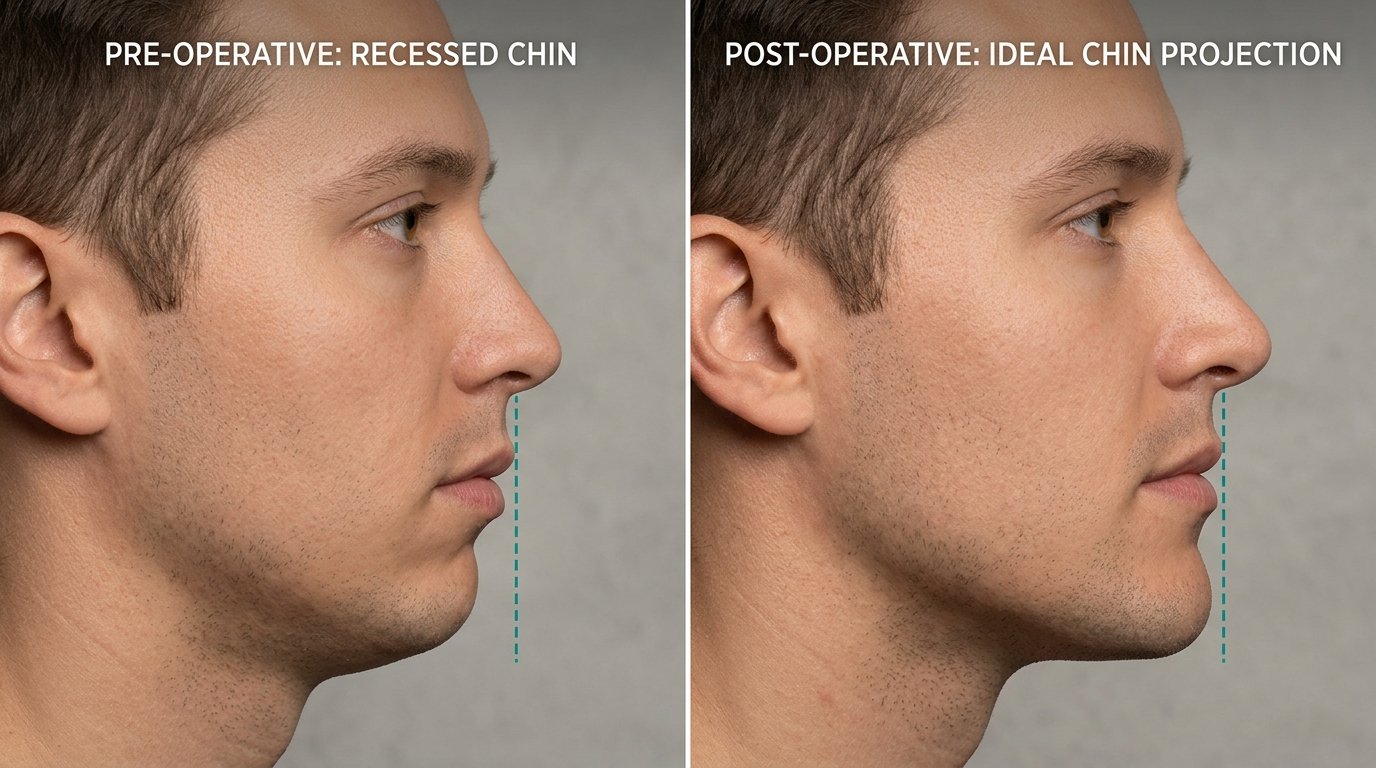
A recessed chin — medically called retrogenia or chin hypoplasia — occurs when the chin tip sits further back than ideal in the facial profile, failing to project forward enough to balance the nose and forehead. It is identified using the Ricketts E-line: if the chin tip falls visibly behind the lower lip in side profile, recession is present. Causes include genetics, jaw skeletal position, childhood mouth breathing, and dental malocclusion. Treatment ranges from chin filler and beard styling to chin implants and genioplasty.
What Is a Recessed Chin?
A recessed chin is a structural condition in which the bony prominence of the chin — the pogonion, the forward-most point of the chin tip — sits further back from the facial plane than aesthetic and functional ideals recommend. Viewed in profile, a person with chin recession appears to have a face that “fades” at the lower third rather than projecting forward to complete the facial silhouette.
In clinical and surgical terminology, a recessed chin may be described as retrogenia (backward chin) or chin hypoplasia (underdevelopment of the chin). It exists on a spectrum from very mild recession that is only visible in photographs, to moderate and severe cases that affect facial function, dental occlusion, airway patency, and self-image significantly.
It is important to distinguish two types:
- Skeletal chin recession (true retrogenia): The mandibular symphysis — the bony chin block itself — is underdeveloped in its forward projection. The rest of the jaw may be normally positioned.
- Skeletal jaw recession (retrognathia): The entire lower jaw is positioned too far back, which pulls the chin with it. This involves dental malocclusion (typically a Class II bite) and is a more complex structural problem involving the entire mandible.
Both produce a recessed chin profile in appearance, but they have different treatment pathways. Understanding which type you have is critical before pursuing any intervention.
Wondering how your chin affects your overall facial proportion score? PSLScaleMe’s free Face Rater analyses your jawline, face thirds, and lower-face definition from a single photo — free and private.
How to Tell If You Have a Recessed Chin: Key Signs
There are several reliable self-assessment methods for identifying a recessed chin, all performed from a strict side-profile photograph taken at eye level with natural head posture (neither chin forward nor tucked).
The Ricketts E-Line Test
Draw a straight line from nose tip to chin tip in profile. In an ideal face, the upper lip is ~4mm behind this line and the lower lip ~2mm. If the lips protrude past the E-line or the chin tip is far behind it, recession is present.
Zero Meridian Check
Draw a vertical from the nasion (nose bridge) straight down. The chin tip should fall within a few millimetres of this line. Males: >4mm behind = recession. Females: >2mm behind = recession.
Blunt Cervicomental Angle
Look at the angle between the underside of your chin and the front of your neck. Ideal is 105–120°. A blunt, poorly-defined, or near-absent angle strongly indicates chin recession or combined submental fat accumulation.
Shortened Lower Facial Third
The lower third (nose base to chin tip) appears visually shorter or less prominent than the middle and upper thirds. The face seems to “end too soon” when viewed in profile.
Lips Ahead of Chin
In profile, the lower lip visibly protrudes beyond the chin tip. In an ideal profile the chin tip should be at or slightly ahead of the lower lip — if the lip is clearly the most forward point, the chin is recessed.
Nose Appears Disproportionately Large
A recessed chin creates an imbalance in the profile that makes the nose appear larger than it structurally is. In many rhinoplasty consultations, a recessed chin is the actual driver of the perceived nose issue.
Self-check tip: Take a true side-profile photo with your head in natural rest position — not deliberately extending your neck or pushing your chin forward. Many people unconsciously jut their chin forward in social situations; the unposed profile tells the real structural story.
Measuring Chin Projection: The Clinical Standards
Aesthetic surgeons and orthodontists use standardised cephalometric (facial measurement) references to quantify chin recession precisely. The two most used are:
The lower facial third measurement is a core part of complete facial proportion analysis — learn to measure all five key metrics from a photo in our full step-by-step guide.
What Causes a Recessed Chin?
A recessed chin is rarely the result of one single cause — it typically reflects a combination of genetic predisposition, developmental patterns, and habitual posture. The following are the most clinically significant causes:
Genetics & Heredity
The size and forward development of the mandibular symphysis is largely genetically programmed. If one or both parents have a recessed chin, the trait is significantly heritable. Ethnicity also plays a role — certain populations show higher prevalence of chin recession.
Jaw Retrognathia
When the entire lower jaw (mandible) is positioned too far back relative to the upper jaw, the chin sits behind its ideal position by default. This is typically associated with a Class II dental malocclusion — where upper teeth significantly overlap lower teeth.
Mouth Breathing
Chronic mouth breathing during childhood and adolescence — when the jaw is still growing — prevents the tongue from resting on the palate and disrupts normal forward jaw development. Research links childhood mouth breathing to narrower arches and less forward chin growth.
Dental Malocclusion
Overbite (deep bite) and overjet (upper teeth protruding significantly over lower) are both associated with chin recession. Misaligned teeth can also mask the true degree of chin underprojection, making measurement without orthodontic correction less precise.
Forward Head Posture
Chronic forward head posture places the head in front of the body’s centre of gravity, which over time can cause adaptive changes in jaw position and chin appearance. While it cannot fundamentally alter bone, it significantly affects how the chin presents in profile photographs.
Bone Resorption & Ageing
The chin bone undergoes resorption (gradual loss) with age — the same process that affects all facial bones. Older adults commonly develop increased chin recession due to mandibular bone loss, even if their chin was adequate in youth.
A recessed chin often co-occurs with a weak overall jawline. Read our complete Jawline-to-Face Ratio guide to understand how your jaw structure is scored and what improvements make the biggest impact.
How a Recessed Chin Changes Your Facial Appearance
The effects of a recessed chin on overall facial appearance extend well beyond the chin itself. Because the chin is the terminal anchor point of the lower facial third, its position influences how multiple surrounding features are perceived — including the nose, neck, lips, and jaw.
| Feature Affected | How Chin Recession Changes It |
|---|---|
| Nose (profile view) | A recessed chin makes the nose appear disproportionately large and prominent — it is further ahead relative to the chin. Many patients seeking rhinoplasty actually need chin augmentation to rebalance the profile. |
| Neck-jaw definition | Reduces or eliminates the cervicomental angle (the clean distinction between chin and neck). The face appears to merge into the neck, making the neck look shorter and fuller. |
| Lower lip | The lower lip appears more prominent than it structurally is, because the chin is not balancing it in the profile plane. |
| Jawline (front view) | The lower face appears softer and less defined from the front. The jaw angle is present but the chin’s lack of forward projection removes visual sharpness from the overall jaw silhouette. |
| Face thirds balance | The lower third appears compressed or underexpressed relative to the middle and upper thirds, disrupting the 1:1:1 proportion balance. |
| Overall profile silhouette | The facial profile lacks a confident terminal point. The ideal profile has a clean, progressive line from forehead to nose tip to chin tip — chin recession interrupts this sequence. |
| Perceived submental fat | Even a person with low body fat and a lean face can appear to have a “double chin” if the chin is recessed — the lack of chin projection creates a visual fold at the chin-neck junction. |
Recessed Chin and Facial Attractiveness
In facial attractiveness research and in AI facial analysis, chin projection is assessed as part of the lower facial third and overall profile balance. A recessed chin has measurable effects on multiple metrics:
It is worth emphasising that a recessed chin does not determine overall attractiveness — facial attractiveness is a composite of many factors, and many highly-rated faces have mildly recessed chins that are compensated by strong cheekbones, symmetry, eye quality, and other features. The chin’s influence is most pronounced in profile view and becomes less dominant in front-facing photographs where other metrics (eyes, cheekbones, symmetry) dominate the assessment.
Chin projection is one component of your overall facial score. Read our guide on how face scanner ratings work to understand how AI tools combine chin position, jaw ratio, symmetry, and other metrics into an overall attractiveness score.
Treatment Options for a Recessed Chin
Treatment for a recessed chin ranges from simple non-invasive techniques to permanent surgical correction, depending on the severity of recession, whether it involves the chin alone or the entire jaw, and the patient’s goals.
Chin Filler (Hyaluronic Acid)
Injectable filler placed at the chin tip and/or mentum to add projection and definition. Typically 0.5–2 ml. Results last 12–18 months. Ideal for mild recession and patients wanting a reversible trial of what augmentation would look like. Not suitable for significant skeletal recession.
Sculptra / Radiesse Filler
Longer-lasting biostimulator fillers that stimulate collagen and provide structural volume. Better for adding chin definition than HA fillers, with results lasting 18–24+ months. Radiesse is particularly popular for chin augmentation due to its firmer consistency.
Beard Styling (Men)
Strategically growing beard volume at the chin — particularly a fuller chin-strap or rounded goatee — optically extends the chin forward and increases its apparent projection. One of the highest-impact, zero-cost interventions for mild chin recession in men.
Mewing & Tongue Posture
Maintaining the tongue pressed against the palate (mewing) promotes forward facial growth in adolescents and may help maintain jaw position in adults. Evidence in adults is limited but the practice has no downsides and may improve posture-related chin positioning over time.
Chin Implant (Mentoplasty / Alloplastic Augmentation)
A solid silicone implant placed through a small incision under the chin or inside the mouth, positioned over the chin bone. Adds permanent forward projection in 3–12mm increments depending on implant size. Most common surgical chin procedure globally. Recovery: 1–2 weeks. Permanent results.
Sliding Genioplasty
The chin bone itself is surgically cut and repositioned forward (and up or down if needed), then fixed with titanium plates. Provides the most precise, multi-dimensional correction and is preferred when both projection and vertical height need adjustment. More complex recovery than implants but considered the gold standard for true retrogenia.
Orthognathic Surgery (Jaw Surgery)
For cases where chin recession is caused by retrognathia (entire lower jaw set back), orthodontic treatment followed by BSSO (bilateral sagittal split osteotomy) moves the entire mandible forward. This simultaneously corrects the bite, chin position, airway, and profile. Most transformative option for true skeletal Class II patients.
Important: If your chin recession is associated with a Class II bite (upper teeth sitting significantly over lower teeth), dental malocclusion, or sleep apnoea, you should consult an orthodontist and oral surgeon before pursuing any cosmetic intervention. Chin implants placed over an uncorrected skeletal jaw problem may produce an unnatural result and can complicate later orthognathic surgery.
The PSL Scale community rates chin projection as a key lower-face metric. Read our guide on what the PSL Scale means to understand how your chin position contributes to your overall facial rating framework.
Recessed Chin in Profile vs. Front View
One important nuance about a recessed chin is that it is fundamentally a profile phenomenon. In a straight front-facing photograph, chin recession may be barely noticeable — the chin may appear of normal size and position because you are looking at its width and vertical extent, not its forward projection. This is why many people are surprised by their profile photographs: a chin that appears fine front-on can look visibly recessed in side profile.
This also means that front-facing AI facial analysis tools, including PSLScaleMe’s face rater, capture chin recession indirectly — through a shorter or less prominent lower third, softer jaw trajectory, and reduced chin width-to-jaw-width ratio — rather than directly measuring sagittal (forward) projection. The clearest and most direct way to identify your own chin recession is always from a strict side-profile photograph using the measurement methods described above.
Frequently Asked Questions
What is a recessed chin?
Is a recessed chin the same as a weak chin?
Can jaw exercises fix a recessed chin?
How much does chin filler cost compared to chin implant surgery?
Does a recessed chin cause sleep apnoea?
How long does recovery from a chin implant take?
Key Takeaways
- A recessed chin (retrogenia) occurs when the chin tip sits further back than ideal in the facial profile — identified using the Ricketts E-line and zero meridian tests
- The two types are: true retrogenia (chin bone underdeveloped) and retrognathia (entire lower jaw set back) — each has a different treatment pathway
- Primary causes are genetics, jaw skeletal position, childhood mouth breathing, dental malocclusion, and forward head posture
- A recessed chin makes the nose appear larger, eliminates the cervicomental angle, softens the jawline, and disrupts lower-face thirds balance
- It is primarily a profile phenomenon — less visible in front-facing photos than in strict side profile
- Non-surgical options: chin filler (temporary, 12–18 months), beard styling for men, improved posture
- Surgical options: chin implant (permanent, fast recovery), sliding genioplasty (gold standard for precise correction), orthognathic surgery (for skeletal Class II cases with bite issues)
- Always rule out retrognathia and dental malocclusion before any cosmetic intervention