
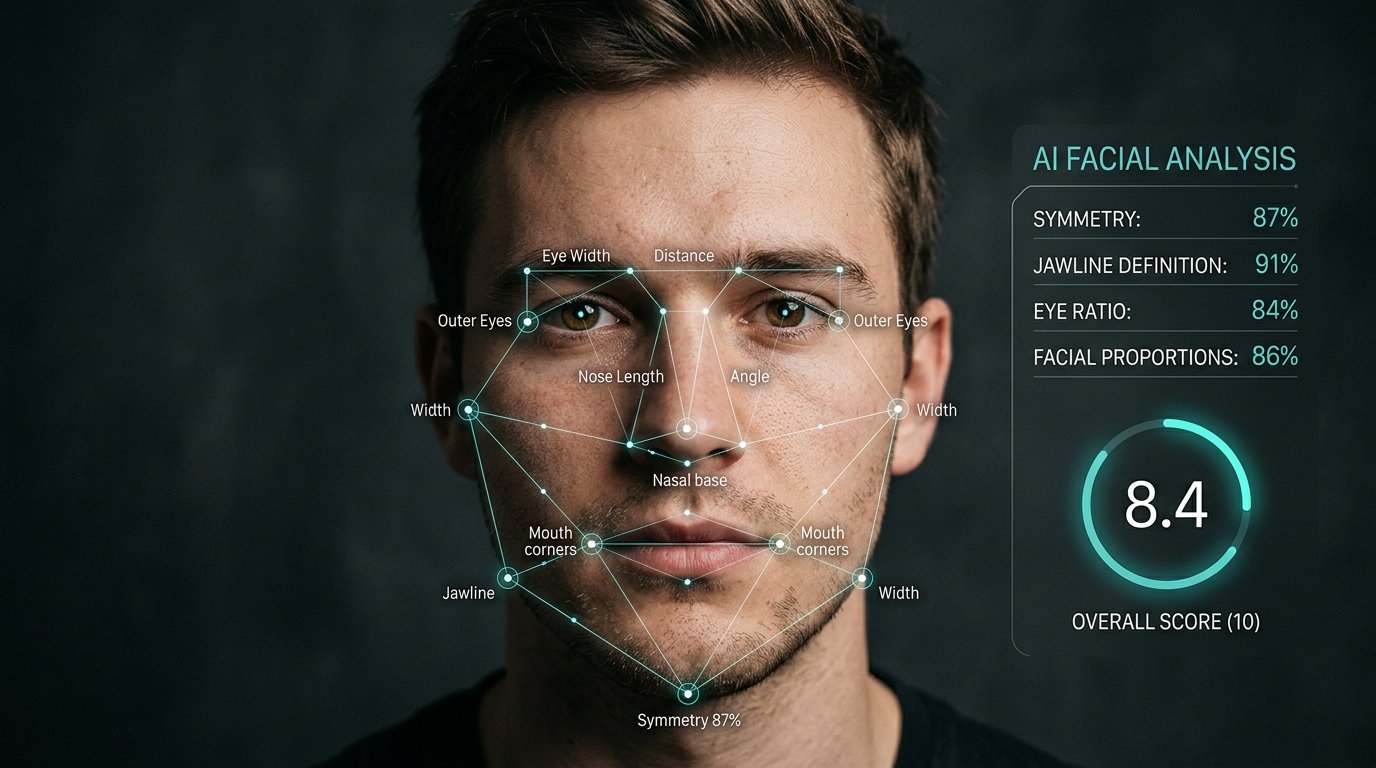
A face scanner rating works by using AI to detect dozens of facial landmarks, then calculating proportional ratios (symmetry, fWHR, eye spacing, jawline ratio, canthal tilt) against research-backed benchmarks. Each metric is scored and weighted to produce an overall face scan score. On a 1–10 scale, 5.5–6.5 is average, 7.0–7.9 is above average, and 8.0+ represents the top 15–20% of all measured faces.
What Is a Face Scanner Rating?
A face scanner rating is a numerical score produced by AI software that analyses the geometric structure of your face from a photograph. Unlike casual “hot or not” apps that rely on crowd voting, a proper facial scanner operates on objective measurement: it detects the precise positions of facial landmarks, calculates proportional ratios between them, compares those ratios to established aesthetic benchmarks derived from scientific research, and converts the results into a structured score.
The concept draws on decades of academic work in evolutionary psychology, anthropometrics, and computational aesthetics. Researchers have long established that certain facial proportions — symmetry, the face width-to-height ratio, eye spacing, jawline definition, canthal tilt — are consistently associated with attractiveness across cultures and demographics. A facial scanner operationalises this research: it converts the abstract science of facial beauty into a concrete, repeatable measurement you can actually see and act on.
Understanding how face scanner attractiveness tools work gives you the power to interpret your score intelligently — knowing exactly which features drove it up, which pulled it down, and what changes would move the needle most meaningfully.
Ready to get your own face scanner score right now? PSLScaleMe’s free Face Rater runs a full geometric analysis from a single photo — private, instant, no account needed.
How a Facial Scanner Actually Works
The technology behind a modern facial scanner rating is more sophisticated than most users realise. There are three distinct phases every legitimate scanner performs: landmark detection, metric calculation, and score synthesis.
Phase 1: Landmark Detection
The first and most critical step is facial landmark detection — the process of identifying precise anatomical points on the face in a 2D image. Modern AI models (most commonly based on MediaPipe Face Mesh or similar architectures) can identify up to 468 individual landmarks with sub-pixel accuracy on high-quality photos.
These landmarks include the inner and outer corners of both eyes, the tip and base of the nose, the corners and midpoints of the lips, the outermost cheekbone positions, the jaw angle points (gonion), the chin tip, and the hairline midpoint. Every subsequent measurement depends entirely on the accuracy of this initial detection — which is why photo quality matters so much. A slightly angled, poorly lit, or low-resolution image will cause landmark positions to shift, producing inaccurate ratio calculations downstream.
Phase 2: Metric Calculation
Once landmarks are mapped, the scanner calculates a set of proportional measurements. Each measurement is a ratio between specific landmark pairs, so the absolute size of the face in the photo is irrelevant — only the relationships between points matter. The core metrics that drive a quality face scan rating are:
Facial Symmetry
Compares corresponding landmark pairs on the left and right halves. Measures how closely the two sides of the face mirror each other across the vertical midline.
Face Width-to-Height Ratio
Cheekbone width divided by upper face height. One of the most researched attractiveness metrics, linked to testosterone and facial balance perception.
Eye Spacing Ratio
The inter-canthal distance (inner corners) compared to one eye width. Determines whether eyes read as close-set, ideal, or wide-set.
Canthal Tilt
The upward or downward angle of the eye opening. Positive tilt signals youth and alertness; negative tilt can read as tired or soft.
Jawline Ratio
Jaw width (gonion-to-gonion) as a proportion of cheekbone width. Encodes information about facial masculinity and lower-face definition.
Face Thirds Balance
The upper, middle, and lower thirds of the face should each represent roughly one-third of total face height for optimal vertical proportion.
Golden Ratio Proximity
How closely multiple facial relationships approximate the golden ratio (φ ≈ 1.618). More of a theoretical benchmark than a hard rule, but meaningful in aggregate.
Nose-to-Mouth Width Ratio
The width of the nose base compared to the width of the mouth. A ratio of approximately 0.75 is associated with balanced mid and lower-face proportions.
Want to understand each metric in depth before you scan? Our guide on how to measure facial proportions from a photo walks through every one of these measurements step by step.
Phase 3: Score Synthesis
Raw metric values are converted into a final face scanner score through a weighted scoring algorithm. Not all metrics carry equal weight — symmetry, fWHR, and jawline ratio are typically weighted more heavily than nose-to-mouth ratio in overall attractiveness correlations. A sex-appropriate weighting is also applied: the jaw ratio threshold for “ideal” differs between a male face and a female face, and canthal tilt standards shift accordingly.
The weighted component scores are then combined into a single composite rating — most commonly presented on a 1–10 scale. Some tools also show sub-scores by facial region (upper third, eye area, lower third) to give you a more granular breakdown of your strengths and weaknesses.
How to Read Your Face Scanner Score
The number you receive from a facial scanner rating is meaningless without context. Here is the full breakdown of what each score range typically represents across the most widely used 1–10 scale.
One crucial point: your face scan rating measures structural geometry only. It captures nothing about skin quality, expression, hair, grooming, posture, or the social and personality signals that contribute enormously to real-world attractiveness. A person with a structural score of 6.5 who carries themselves with confidence, maintains great skin, and styles themselves well will consistently outperform someone with a 7.5 score who does none of those things. The scanner reads the blueprint, not the finished product.
The PSL Scale is the established framework used by facial rating communities. Read our guide on what the PSL Scale means to understand how structural scores translate into real-world tiering.
What Face Scanners Cannot Measure
The most important thing to understand about any face scanner beauty score is what falls outside its scope. A geometric scan is inherently limited to what proportional measurement can capture — which leaves out several factors that significantly influence perceived attractiveness.
| Factor | Impact on Attractiveness | Detectable by Face Scanner? |
|---|---|---|
| Skin clarity & texture | Very high — rivals symmetry in attractiveness impact | No — flat photo only |
| Facial expression & warmth | High — a genuine smile increases attractiveness meaningfully | No — requires neutral expression |
| Grooming & hairstyle | High — can visually reshape face shape perception | Partially — hair is excluded from structural scoring |
| Posture & body language | Moderate — projects confidence and status | No — photo is face-cropped |
| Voice, scent & movement | Moderate — powerful in-person attraction drivers | No — photo-based only |
| 3D facial depth & projection | Moderate — chin and cheekbone projection read very differently in person | Limited — 2D photo only |
| Lighting & photography | Variable — can dramatically change perceived proportions | Partially — quality scanners correct for some bias |
This is not a flaw unique to any single tool — it is an inherent limitation of 2D photo-based facial analysis. The best face scanner online tools acknowledge this openly and present their output as structural analysis, not a verdict on your overall attractiveness or worth.
Symmetry is the single highest-weighted metric in most face scanner algorithms. Read our deep-dive on facial symmetry to understand exactly what it measures and how it contributes to your score.
How to Get the Most Accurate Face Scanner Rating
Your score will only be as accurate as the photo you provide. The following conditions consistently produce the most reliable face rating from photo results across all scanner types.
Camera at eye level. Any upward or downward angle distorts perceived face height and fWHR substantially.
Even, diffuse frontal lighting. Overhead or side lighting creates shadows that shift landmark positions and skew symmetry scores.
Hair pulled completely back. Hair covering the forehead hides trichion (hairline) and falsifies upper third measurement.
Neutral expression, relaxed jaw. Smiling raises the cheeks and alters eye position. A clenched jaw widens the apparent bigonial width.
High resolution, no filters. Beauty filters alter skin tone gradients and can subtly reposition landmark detection nodes.
Take 3 photos, use the best. Micro-head-tilts and slight expression differences between shots affect results. Pick the most neutral and level one.
Before your scan, it helps to know your face shape — it gives context to your scanner results. Use our free Face Shape Detector to identify yours in seconds.
Face Scanner vs. Human Rating: Which Is More Reliable?
This is one of the most commonly asked questions about face scanner attractiveness tools — and the answer is nuanced. Both AI scanners and human raters capture real but different dimensions of facial attractiveness.
🤖 AI Face Scanner
- Fully objective — no mood, bias, or personal taste
- Measures geometric proportions with high precision
- Perfectly consistent — same photo always gives same result
- Benchmarked against cross-cultural research data
- Cannot measure skin quality, expression, or 3D depth
- Highly sensitive to photo conditions
👤 Human Rater
- Captures holistic impression including skin, expression, grooming
- Registers personality signals projected through the photo
- Subject to cultural bias, personal taste, and rater mood
- Highly inconsistent between raters and over time
- Better at capturing “it factor” and charm
- Cannot explain why a face is or isn’t attractive
The most complete picture of your facial attractiveness comes from using both. A facial scanner rating tells you what your structural geometry looks like on paper — your baseline, your blueprint, the fixed variables. Human feedback tells you how that structure is landing in practice, filtered through social context and expression. Neither alone gives the full story.
pslscaleme is built specifically to bridge this gap: its scanner provides transparent metric-by-metric breakdowns rather than a single opaque number, so you understand which structural factors are driving your score and can use that information constructively.
What Can You Do With Your Face Scanner Score?
A score without actionable takeaways is just a number. The real value of a face scanner score lies in what it reveals about which specific metrics are limiting your overall rating — because those are precisely the areas where targeted effort yields the highest return.
- High symmetry, low jawline ratio: Focus on jaw definition — body fat reduction, jaw exercises, and beard styling will have the most visible structural impact.
- Strong fWHR, negative canthal tilt: Cat-eye makeup or lateral Botox can shift perceived eye tilt significantly. A lateral canthoplasty is the surgical option for permanent change.
- Imbalanced face thirds (long lower third): Chin reduction or lip augmentation addresses this structurally; strategic beard shaping or makeup contouring can manage it without intervention.
- Low symmetry score: Asymmetry is often caused or worsened by lifestyle factors — sleep position, chewing habits, and posture. Cosmetic injectables can address volume asymmetries directly.
- Close-set or wide-set eye spacing: This cannot be structurally altered without surgery, but eyebrow shape and makeup can create a powerful optical illusion of corrected spacing.
Your jawline score has an outsized effect on overall scan results. Read our full guide on the Jawline-to-Face Ratio to understand your jaw metric and how to improve it.
How to Scan My Face and Rate It: Step-by-Step
If you want to scan your face and rate it right now, here is the complete process from photo to score.
- Take your reference photo. Straight-on, camera at eye level, hair back, neutral expression, good even lighting. Higher resolution is better.
- Choose a reputable face scanner. Look for tools that show metric breakdowns rather than just a single number, and that clearly state they do not store your photos. PSLScaleMe processes your image entirely in your browser.
- Upload or capture your photo. Most tools accept JPEG or PNG. Avoid screenshots of photos, as they introduce compression artefacts.
- Review your full metric breakdown. Don’t just look at the overall score — examine each component. Note which metrics are above benchmark (strengths) and which fall below (areas of focus).
- Contextualise your result. Remember the photo conditions: if the lighting was off or the angle slightly wrong, your score may be lower than your structural reality. Retest with an improved photo if in doubt.
- Use the results constructively. Identify the one or two metric areas with the most room for improvement. Prioritise high-impact, low-effort changes first — grooming, styling, and skin quality before considering any interventions.
Frequently Asked Questions
How does a face scanner rating work?
Are face scanner ratings accurate?
What is a good score on a face scanner?
Can I scan my face and rate it for free online?
Why did my face scanner score change between photos?
Does a face scanner rate attractiveness the same way for men and women?
Key Takeaways
- A face scanner rating uses AI landmark detection to calculate proportional ratios and compare them to research-backed attractiveness benchmarks
- The core metrics are: facial symmetry, fWHR, eye spacing, canthal tilt, jawline ratio, face thirds balance, and golden ratio proximity
- On a 1–10 scale, 5.5–6.5 is average, 7.0–7.9 is above average, and 8.0+ is top 15–20%
- Face scanners measure geometry only — skin quality, expression, grooming, and personality are outside their scope
- Photo conditions (angle, lighting, expression) significantly affect result accuracy — always use a controlled, neutral front-facing photo
- Use your metric breakdown to identify your strongest and weakest areas, then prioritise high-impact styling and structural improvements
- AI scanners provide objectivity and consistency; human raters provide holistic context — both together give the most complete picture