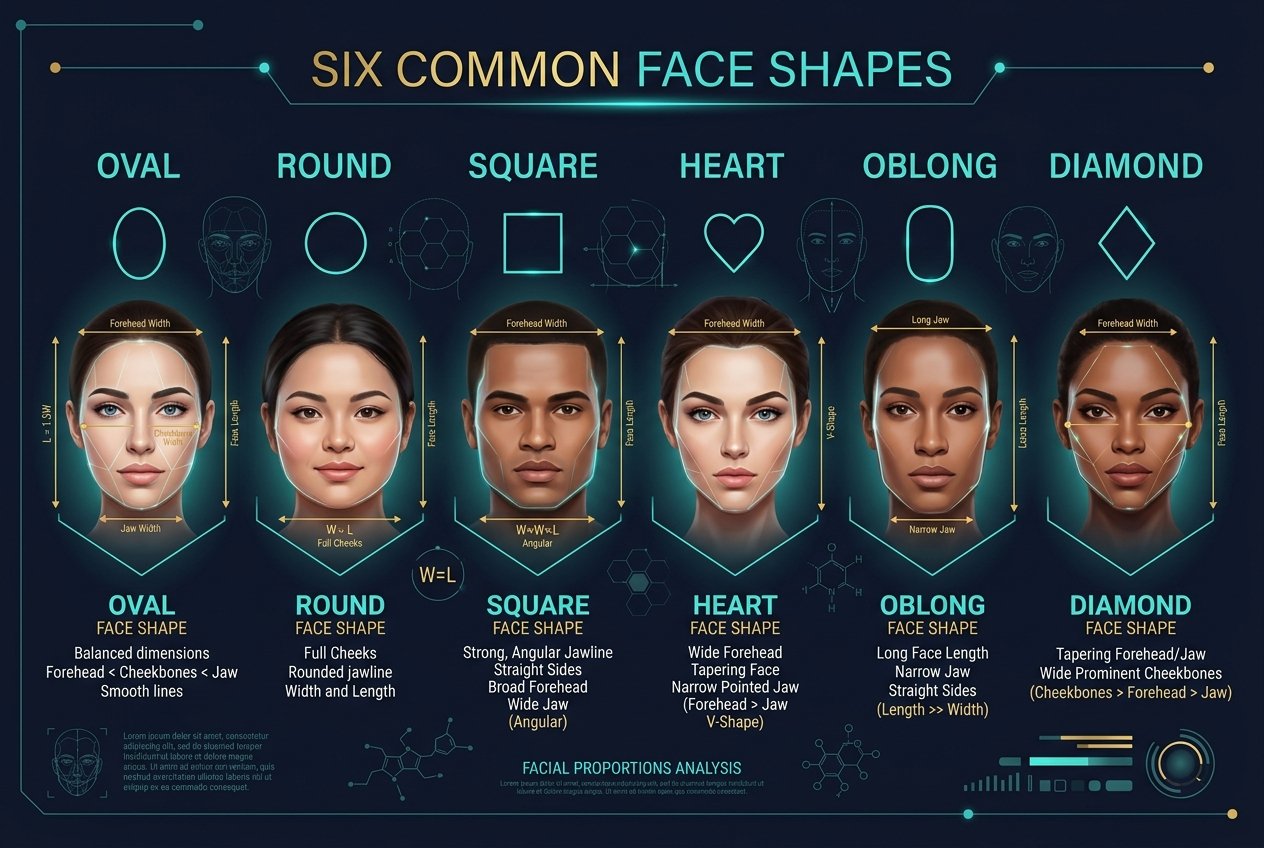
To identify your face shape, measure four things: forehead width, cheekbone width, jaw width, and face length. Compare those numbers to find which of the six shapes fits best: oval, round, square, heart, oblong, or diamond. If the numbers do not point cleanly to one shape, look at which features are most prominent and work from there. Most faces sit between two shapes.
Why Knowing Your Face Shape Actually Matters
Your face shape affects more practical decisions than most people realise. It influences which hairstyles will frame your face well, which glasses frames flatter your proportions, which makeup techniques create balance, and how your features read to others at different angles.
The reason face shape has such practical value is geometric: different shapes have different widths at the forehead, cheekbones, and jaw. A hairstyle that adds volume at the crown looks great on an oblong face and wrong on a round one. A sharp square jaw benefits from rounded styling; a soft round jaw benefits from structured styling. Knowing your shape lets you work with your geometry rather than against it.
The fastest and most accurate way to check is our free Face Shape Detector tool which gives you an instant result from a photo. But if you want to understand the process properly, here is the complete method.
How to Measure Your Face Shape Step by Step
You need a flexible tape measure and a mirror. Take the measurements at rest with a neutral expression. Pull your hair back so it does not affect the readings.
-
Forehead width: Measure horizontally from one hairline edge to the other at the widest point of your forehead. For most people this is roughly halfway between the eyebrows and the hairline. Write it down in millimetres.
-
Cheekbone width: Measure from one cheekbone to the other at their widest point. This is typically at the outer corners of the eyes or just below them. This is usually the widest measurement on the face.
-
Jaw width: Measure across the jaw at its widest point, which is usually just below and in front of the ears where the jaw angles forward. Do not measure at the chin tip.
-
Face length: Measure vertically from the centre of your hairline straight down to the tip of your chin.
-
Compare the numbers: Use the table below to match your measurements to the closest face shape. Look at which widths are larger or smaller relative to each other and how length compares to width overall.
| Face Shape | Forehead | Cheekbones | Jaw | Length vs Width |
|---|---|---|---|---|
| Oval | Slightly smaller than cheekbones | Widest point | Narrower than forehead | Length noticeably greater than width |
| Round | Similar to jaw width | Similar to length | Soft, rounded | Length roughly equals width |
| Square | Similar to jaw width | Similar to forehead | Strong, angular, nearly equal to forehead | Moderate, not very long |
| Heart | Widest point on face | Moderate | Narrow, pointed chin | Length greater than width |
| Oblong | Similar to jaw | Similar to forehead and jaw | Similar to forehead | Length significantly greater than width |
| Diamond | Narrower than cheekbones | Widest by a clear margin | Narrow, similar to forehead | Moderate length |
Skip the measuring. Our free Face Shape Detector tool analyses your photo and identifies your shape instantly with no measuring required.
The Six Face Shapes: A Clear Breakdown
◯ Oval
Cheekbones are the widest point. Forehead is slightly wider than the jaw. The face is noticeably longer than wide. The jawline is gently rounded without sharp angles.
- Your cheekbone width is the largest of the four measurements
- Jaw is clearly narrower than forehead
- Length is 1.3 to 1.5 times the cheekbone width
- No strongly prominent feature: the face reads as balanced
The most versatile face shape for styling. Almost all hairstyles and glasses work well. No corrective styling needed.
⬤ Round
Face length and cheekbone width are approximately equal. The jaw is wide and soft with no sharp angles. The forehead and jaw widths are similar. The overall shape feels circular.
- Length and width differ by less than 10 percent
- No strongly angular features: jaw curves rather than angles
- Forehead and jaw read as approximately equal widths
- Cheekbones are the widest point but not by much
Very common across all ethnicities. Styling focus is on adding length and definition to avoid amplifying the circular impression.
■ Square
Forehead, cheekbones, and jaw are all approximately equal in width. The jaw has a strong, angular corner rather than a soft curve. The face is not significantly longer than wide.
- All three widths are within 10 percent of each other
- The jaw angle is visible and defined, not rounded
- Face length is not dramatically greater than width
- The face reads as structured and symmetrical
Associated with strong bone structure. Very common in both male and female faces. Styling aims to soften the jaw angle while maintaining the structured impression.
▲ Heart
The forehead is the widest point. Cheekbones are moderately wide. The face narrows significantly toward a pointed or very narrow chin. A widow's peak hairline is common.
- Forehead is clearly wider than cheekbones
- Jaw is noticeably narrower than both forehead and cheekbones
- Chin is pointed or narrow rather than squared or rounded
- The wide-to-narrow taper from top to bottom is pronounced
Also called inverted triangle. Styling focuses on adding width at the jaw and reducing visual emphasis on the forehead.
▮ Oblong
The face is significantly longer than it is wide. Forehead, cheekbones, and jaw are all approximately similar in width. There are no strongly prominent features: the defining characteristic is length.
- Face length is 1.75 times or more the cheekbone width
- Forehead, cheekbones, and jaw measurements are all close
- No one width significantly dominates the others
- The overall impression is vertical: tall and narrow
Also called rectangle or long face shape. Styling focuses on adding horizontal width to visually shorten the face.
♦ Diamond
Cheekbones are the widest feature by a clear margin. The forehead is narrow, and the jaw is also narrow. The face tapers both upward from the forehead and downward from the jaw, with wide mid-face prominence.
- Cheekbones are clearly wider than both forehead and jaw
- Forehead and jaw are similar in width to each other
- The face reads as widest in the middle
- Cheekbones are highly prominent and defining
The rarest of the six main shapes. Prominent cheekbones make this one of the most distinctive and photogenic face shapes. Styling focuses on the forehead and chin to balance the prominent mid-face.
What to Do When You Fall Between Two Shapes
Most people do not match one face shape cleanly. A face that sits between oval and square is very common. One between round and heart is equally so. This is not a problem: it means you have the defining characteristics of both shapes.
When you are between two shapes, identify which features are more dominant and work from those. If you are between oval and square, look at your jaw: is it curved and soft or angular and defined? The jaw answer tells you which of the two shapes should drive your styling decisions.
You can also think about it in terms of what you want to create visually. Between round and oval? Style as oval to add length. Between square and heart? Focus on which is more prominent: the forehead width or the jaw definition. Let the most prominent feature guide you.
Face proportions change how balanced each shape reads. Read about the face width-to-height ratio to understand how length and width interact in facial geometry.
Common Mistakes When Identifying Face Shape
⚠ 5 Mistakes That Lead to Wrong Results
- Using a photo with hair down: Hair obscures the forehead and changes how wide the face looks. Always pull hair back completely before assessing shape, whether measuring manually or using a tool.
- Measuring at the wrong jawline point: Most people measure the chin rather than the jaw width. Jaw width is taken at the widest point of the jaw, just below and forward of the ears, not at the chin tip. Getting this wrong makes square faces look heart-shaped.
- Using a photo taken at an angle: Face shape identification requires a straight-on, front-facing photo at eye level. Upward or downward angles distort the forehead-to-jaw ratio significantly.
- Relying only on visual impression: Many people identify their shape by looking in the mirror and picking the word that sounds right. Without measurements, this produces wrong answers for most people. The perception of roundness or squareness is heavily influenced by hairstyle and makeup that alter apparent proportions.
- Picking the aspirational shape rather than the actual one: Oval is the most desired shape, so many people identify as oval when they are round or square. Be objective. Work with your actual shape: every shape has great styling options specific to it.
What to Do With Your Face Shape
Once you know your face shape accurately, it becomes useful across several areas.
Hairstyles
Face shape is the most important factor in choosing a hairstyle that works. Every face shape has a clear set of styles that complement it and styles to avoid. Oval faces are the most flexible. Round faces benefit from volume at the crown and styles that add length. Square faces look great with soft waves or layers that reduce the jaw emphasis. Heart faces balance well with styles that add volume at the jaw level.
Get specific style recommendations. Read the full guide on the best hairstyles for every face shape with detailed tips for each of the six shapes.
Glasses Frames
The general principle for glasses is contrast: choose frames that contrast your face shape rather than echo it. Round faces benefit from angular frames. Square faces benefit from round or oval frames. Heart faces benefit from frames that are wider at the bottom than the top. Oval faces work with almost all frame shapes.
Makeup Contouring
Contouring uses shading and highlight to reshape the apparent proportions of the face. Knowing your actual shape tells you where to add shading to narrow and where to add highlight to widen. Round faces benefit from contouring along the cheeks and sides of the forehead. Square faces benefit from contouring at the jaw corners. Oblong faces benefit from horizontal highlight across the cheeks.
Photography Angles
Certain camera angles flatter certain face shapes more than others. A slight three-quarter angle works well for square faces by showing the jaw at its most defined. A straight-on angle works best for heart faces because it minimises the forehead width. Knowing your shape lets you direct photographers and take better selfies.
Facial symmetry affects how balanced your shape reads from any angle. Read the complete guide to facial symmetry to understand how bilateral balance interacts with face shape perception.
Can Your Face Shape Change Over Time?
The bone structure underneath is largely stable after the mid-20s. The overlying soft tissue is not. Facial fat pads redistribute, descend, and reduce with age. Skin loses elasticity and conforms less tightly to the underlying structure. These changes shift how the face reads in terms of shape.
Someone who had a defined square jaw at 25 may find that jaw definition softens by 45 as the soft tissue changes. A heart-shaped face at 30 may read closer to oval at 50 as the mid-face fills relative to the chin area. This is normal and does not require any intervention: it just means face shape identification is more of a periodic check than a permanent label.
Weight changes also affect face shape significantly. Adding weight to the face rounds the jaw and fills the cheeks, shifting the shape toward rounder and wider. Losing weight reveals more bone structure and angularity, often shifting the shape toward square or heart.
💡 Quick Self-Check: The 3-Question Method
- Is your face longer than it is wide? If yes strongly, look at oblong or oval. If no, look at round or square.
- Is your jaw the widest part, similar to your forehead, or narrower? Similar to forehead with angles = square. Clearly narrower with a point = heart. Soft and curved = round or oval.
- Are your cheekbones dramatically wider than everything else? If yes, diamond is likely. If cheekbones are the widest but not dramatically so, you are in oval or round territory.